




PLC Program for Slide Rail Control and Calibration System Adaptation on a Measuring Set, for a Manufacturer of Gauges and Workpiece Measuring Systems
The PLC program in this case commands the slide rail of a workpiece measuring set to operate in the agreed step sequence (Flow), and we reworked the calibration system to operate with the slide rail. This work is Phase 2, following the workpiece measuring system we developed for the same manufacturer of gauges and workpiece measuring systems in 2019, and the project closed in 2020.
- Industry
- General manufacturing
- Year
- 2020
- Scope of work
- Phase 2 of the workpiece measuring system, following the first phase in 2019: writing the slide rail control program via PLC according to the agreed Flow, and reworking the calibration system to operate with the slide rail.
Summary
- This work is Phase 2 of the workpiece measuring system for a manufacturer of gauges and workpiece measuring systems, following the first phase in 2019, and the project closed in 2020.
- We wrote the slide rail control program on a PLC according to the agreed step sequence (Flow).
- We reworked the calibration system to operate with the slide rail.
- The scope of work was still changing during development, so we switched to working with Scrum (dividing the work into short cycles).
The on-site brief
The customer already had workpiece measuring software that read values from multi-channel measuring probes, from the 2019 project. For the next phase, the customer wanted the measuring set's slide rail (Slide) to operate in the agreed step sequence, and the calibration system to operate with the slide rail.
What we did
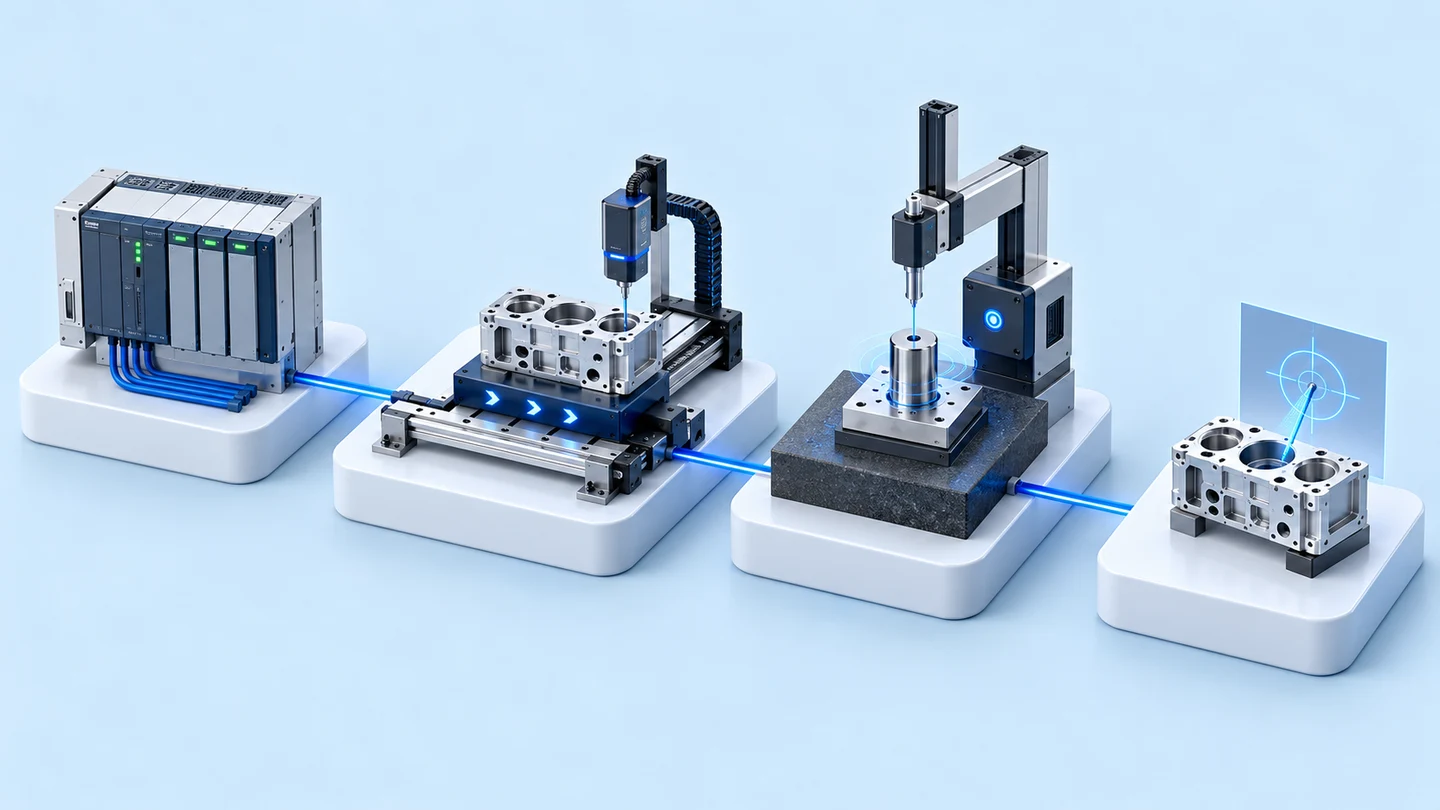
We wrote the slide rail control program on a PLC (a programmable industrial controller) according to the agreed Flow, and reworked the calibration system to operate with the slide rail. The scope of work was still changing during development, so we switched to working with Scrum (dividing the work into short cycles).
Results
We delivered the work and closed the project in 2020. The customer's measuring set has a PLC program that commands the slide rail in the agreed sequence, and a calibration system that operates with the slide rail.
How the brief came about
The brief for this work was to have the slide rail of the workpiece measuring set operate in the agreed step sequence, and to have the calibration system operate with the slide rail. The customer is a manufacturer of gauges and workpiece measuring systems. This work is Phase 2, following the workpiece measuring system we developed for the same customer in 2019
In the first phase, we built workpiece measuring software that reads values from multi-channel measuring probes, displays the results on screen and can export measurement reports as Excel files. When the first phase closed, the next planned work was controlling the measuring set's slide rail.
What is a PLC, and what is calibration?
A PLC (Programmable Logic Controller) is an industrial controller whose operating sequence can be programmed. It is used to command machines or equipment to repeat the same steps. Calibration means setting the values a measuring instrument reads to match a reference value, such as a master workpiece of precisely known dimensions.
Requirements and constraints
The main requirements and constraints of Phase 2 are as follows.
- The slide rail must operate in the agreed step sequence (Flow).
- The calibration system must operate with the slide rail.
- The scope of work was still changing during development, so the way of working had to accommodate change.
The chosen approach and the reasons for it
We used the agreed Flow as the criterion for the PLC program and adapted the calibration system to suit the slide rail. The scope of work was still changing during development, so we switched to working with Scrum, which divides the work into short cycles and reviews the results in every cycle, so that the work could be adjusted to the changing scope one part at a time.
What did Phase 2 deliver?
Phase 2 delivered 2 parts: the PLC program that controls the slide rail, and the calibration system reworked to operate with the slide rail. This work is Phase 2, following the first-phase workpiece measuring system.
- Slide rail control program on a PLC, following the agreed Flow
- Calibration system reworked to operate with the slide rail
Confirmed results
In 2020, we delivered the work and closed Phase 2 of the workpiece measuring system for the manufacturer of gauges and workpiece measuring systems, according to our annual project summary records. The customer's measuring set has a PLC program that commands the slide rail in the agreed sequence, and a calibration system that operates with the slide rail.
This case has no business performance figures, so we report only what was delivered. Phase 2 itself is continuing work from the workpiece measuring system we delivered to the same customer in 2019.
What we learned
This work offers the following principles for control work on measuring sets with moving parts.
- Agree the measuring set's step sequence clearly before writing the PLC program, because the agreed Flow can serve as the criterion both for writing the program and for checking the work. In this work, the agreed Flow was the criterion for the slide rail control program.
- When the scope of work is still changing, divide the work into short cycles and review the results in every cycle. In this work, we switched to working with Scrum during development because the scope was not yet settled.
- Calibration must be planned together with the operating sequence of the moving parts. In this work, the calibration system had to be reworked to operate with the slide rail, so the calibration steps should be defined in the Flow from the start.
How can you apply this approach to your measuring set?
If your measuring set has moving parts, such as a slide rail, and you need them to operate in a defined sequence, you can use the same approach as this case: write the PLC program according to the agreed Flow, then adapt the calibration system to operate with it. What needs adapting depends on the equipment and measuring system you already have.
Reusable parts and parts that need adapting
| Part of the work | Reusable | Needs adapting when |
|---|---|---|
| Step sequence (Flow) | Agreeing the Flow clearly before writing the program | If your measuring set has different measuring points or moving parts from this case, the Flow must be rewritten. |
| Control program | The approach to writing a PLC program so that the slide rail operates according to the Flow | If the PLC or drive equipment is a different model, the program must be written to match the equipment used. |
| Calibration | Adapting the calibration system to operate with the slide rail | If the reference values or master workpiece differ from before, the calibration steps must be redefined. |
| Dividing the work into phases | Build the value-reading system first, then control the moving parts. | If there is no system for reading measuring instruments yet, start with this part first, as in the first phase of this case. |
- Agree clearly from the outset which party is responsible for each part of the measuring set, such as the electrical and electronic systems, the PLC program and the measuring software.
- Check that the measuring set's electrical and electronic systems are ready before testing.
- Plan testing together from the outset, including the reference values to be used for calibration.
Start with an overview of your existing measuring set
If you already have measuring software or measuring instruments, please prepare the models of your probes or instruments, screenshots of the existing program and the measuring sequence actually in use. We can then assess more quickly which parts can be built upon and which must be redone.
Read more
- First-phase case: system for reading multi-channel measuring probes and storing workpiece measurement results
- Custom inspection and control system development service
- System care and maintenance service
- Case: PLC System Check for Chulabhorn Royal Academy
- InGauge — sending values from Digimatic measuring instruments to a computer
Technology used
Frequently Asked Questions
Which part of the measuring set did Inspektion work on in this case?
We wrote the slide rail control program on a PLC according to the agreed Flow, and reworked the calibration system to operate with the slide rail. This work is Phase 2, following the workpiece measuring system we developed in 2019.
Does all the existing measuring software have to be replaced?
It depends on your existing system. The work in this case is Phase 2, following the first-phase workpiece measuring system in 2019. For your measuring set, we need to look at your existing software and measuring instruments first before we can say which parts can be built upon.
Can a project start if the scope of work is not yet settled?
Yes, it can, but the main Flow should be agreed before the PLC program is written. In this case, the scope of work changed during development, so we switched to working with Scrum, which divides the work into short cycles and reviews the results in every cycle.
What should I prepare before asking you for an assessment?
Please prepare the operating Flow you want, the models of the PLC and measuring instruments in use and the reference values used for calibration, and let us know which parts of the measuring set you look after yourself.
How much does it cost?
There is no standard price for this type of work. You can request a quotation, and we will assess it based on the scope of work and the actual condition of the measuring set.