




AI system searches valve repair history from maintenance inspection reports for oil refinery maintenance work
Customer: International Industrial Technology Company
This is an AI Knowledge Management system on nimitFlow that enables the oil refinery maintenance team to create digital maintenance inspection reports for valves, export reports as Excel files, and query repair history through AI chat. We delivered the system in B.E. 2569 and the client signed off on the completion certificate.

- Industry
- Energy
- Year
- 2026
- Scope of work
- nimitFlow Full Enterprise licence and development of an Enterprise AI Knowledge Management system: valve maintenance inspection report forms, data structure and report export to Excel, dashboards by production unit, and a question-and-answer AI assistant (RAG), including tuning of the search and the instructions sent to the model (Prompt)
Summary
- We developed an AI Knowledge Management system on nimitFlow that lets an oil refinery maintenance team search control valve repair history, and delivered it in 2026.
- The starting data was about 2,000 PDF maintenance inspection reports, separated by Tag No. (the valve identification code), which could not be searched across reports and were difficult to aggregate.
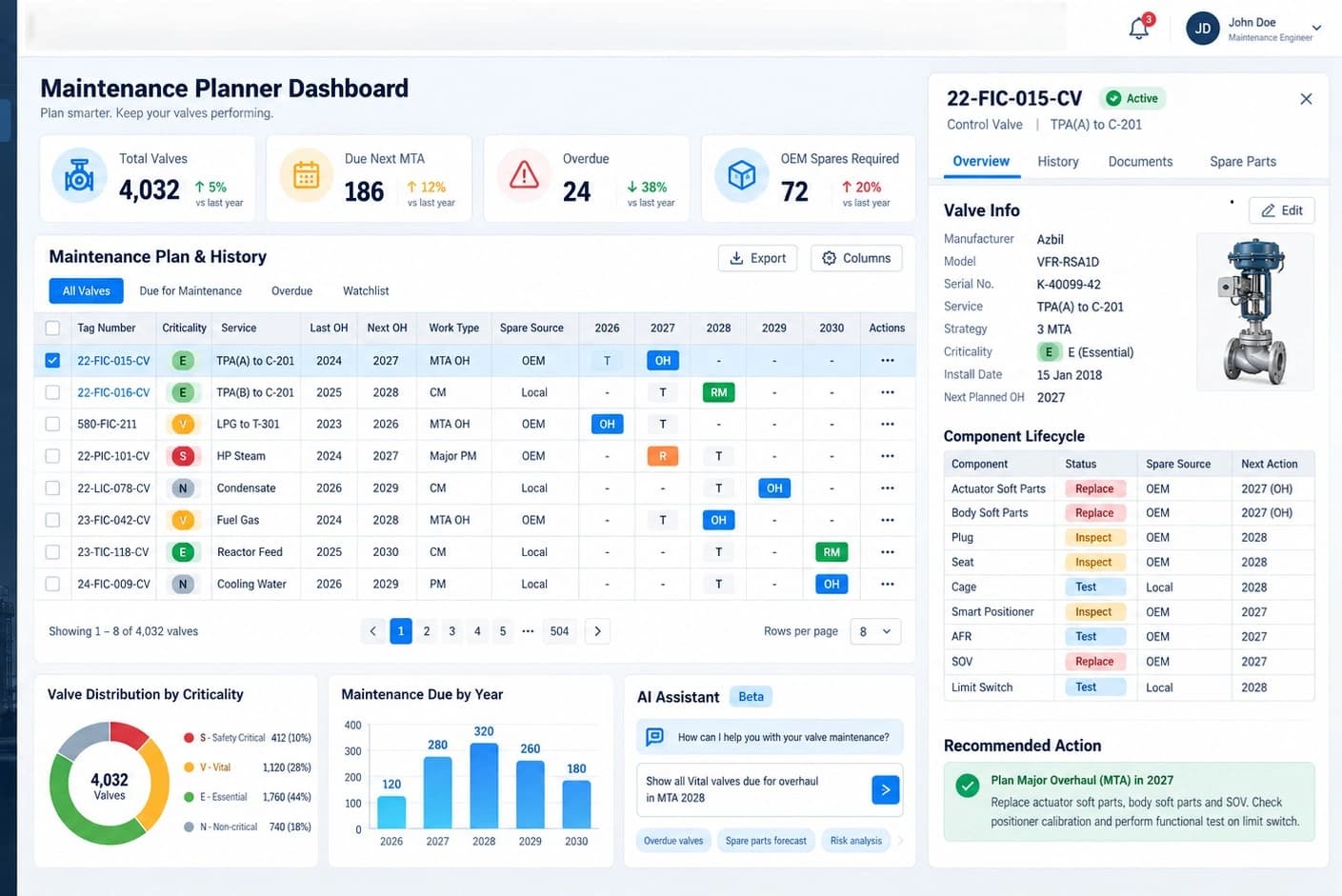
- The delivered system has 4 parts: a digital report form that accepts photo attachments, report export to Excel files, dashboards by production unit and a chat-based AI assistant.
- The AI assistant uses an LLM (large language model) together with RAG (searching for relevant reports before answering) and states the Tag No. of the reports used for the answer, so that the actual reports can be opened and checked.
- Questions that aggregate across the whole dataset should be answered from structured data, because RAG retrieves only the most relevant portion of the reports.
The on-site brief
The refinery's control valve maintenance inspection history sat in about 2,000 PDF reports, separated by Tag No. (the identification code of each valve). Engineers had to open the reports one file at a time to find which valve was leaking or which spare parts had already been replaced, and the data in the PDFs was difficult to aggregate into an overall picture.
What we did
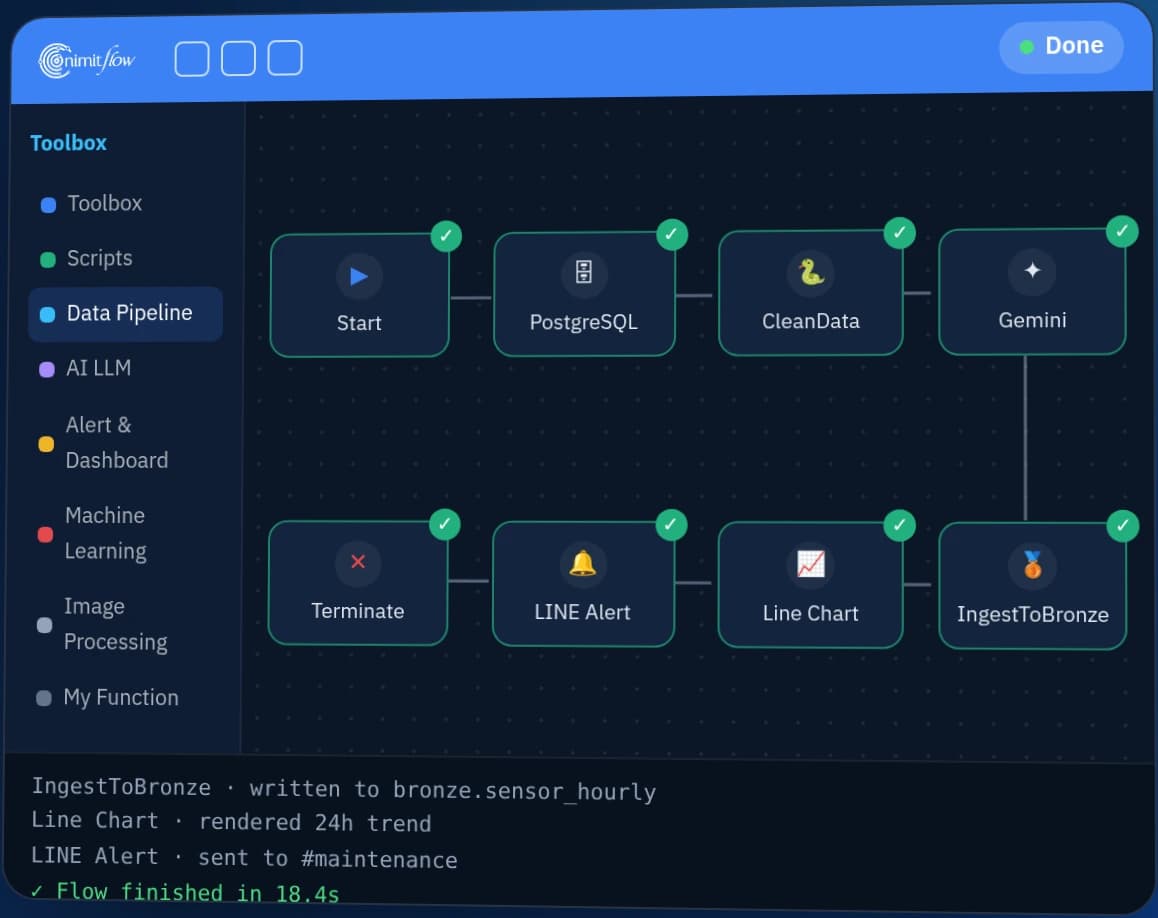
We developed a system on nimitFlow in 4 parts: a digital maintenance inspection report form that accepts photo attachments, report export to Excel files, a dashboard that consolidates reports by production unit, and a chat-based AI assistant (Enterprise KM Chatbot) that uses an LLM (large language model) together with RAG (searching for relevant reports before answering). The project began with a prototype (POC) for demonstration and was then developed into a working system.
Results
We delivered the system in 2026 and the client signed a Job Completion Certificate. The AI assistant is designed to answer questions such as "What has been replaced on this valve Tag?" by stating the Tag No. of the reports used for the answer, so that the actual reports can be opened and checked.
How the brief came about
The challenge in this case was to search the repair history of each control valve from one place. Each maintenance inspection report records the condition of the parts found, the spare parts replaced and the post-repair test results, but these reports were about 2,000 PDF files separated by Tag No., so the data could not be searched across reports.
A refinery has a large number of control valves, and each one accumulates a history of several repairs. Deciding whether to repair again, replace spare parts or plan the next inspection round requires that valve's past data. With the data in PDFs, a question like "What has been replaced on this valve?" meant opening the reports one file at a time.
Requirements and constraints
The system had to use the existing reports as its starting data and accept new reports in the same format. The main requirements and constraints were as follows:
- The starting data was the existing PDF reports, which had to be arranged into a single structure before they could be searched across reports.
- New reports had to be completed through a digital form with photo attachments, with headings matching the reports the team already used.
- Reports had to be exportable as Excel files.
- AI answers had to state the Tag No. of the reports used for the answer, so that users could open the actual reports and review them.
- The system was developed on nimitFlow (a Low-Code platform for building business systems) under a Full Enterprise licence.
Why reports must be organised into structured data before AI answers
Because AI searches and summarises well when every report has the same headings, we first arranged the report data into a single structure on nimitFlow, then had the AI assistant search and summarise answers from that dataset. The same dataset can also be exported to Excel and displayed on dashboards without going through AI.
We chose RAG instead of having the model answer from general knowledge, because the maintenance team's questions are about the refinery's own valves. Answers therefore have to be based on the actual reports and be able to show which Tag No.'s report they came from. Decisions to repair or replace spare parts remain with the engineers.
What is RAG?
RAG (Retrieval-Augmented Generation) is a method in which AI first searches for the organisation's documents relevant to a question, then composes an answer from the content found. The answer is therefore based on content from actual documents, rather than on the model's general knowledge alone.
Deliverables
We delivered a nimitFlow Full Enterprise licence and a 4-part Enterprise AI Knowledge Management system, along with tuning of the RAG search and the instructions sent to the model (Prompt).
- Valve maintenance inspection report form: data entry and photo attachments on nimitFlow
- Data structure and export: reports stored by Tag No. and exported as Excel files
- Dashboard: consolidates reports by production unit
- Chat-based AI assistant (Enterprise KM Chatbot): answers questions from reports using an LLM together with RAG, stating the Tag No. of the reports used for the answer
Work steps: from prototype to working system
This project began with a prototype (POC) before being developed into a working system. The prototype demonstrated that the AI assistant could answer questions from the reports. We then developed the forms, data structure, Excel export, dashboard and AI assistant in the actual system.
- Prototype (POC): demonstrating questions and answers from maintenance inspection reports
- System development on nimitFlow: forms, data structure, Excel export, dashboard and AI assistant
- Tuning of the RAG search and the instructions sent to the model (Prompt)
- System delivered to the maintenance team in 2026
Results confirmed from the delivery
The confirmed result is the Job Completion Certificate signed by the client, after we delivered the AI Knowledge Management system to the oil refinery maintenance team in 2026.
The AI assistant is designed to answer questions such as "What has been replaced on this valve Tag?" or "Which reports found a leak?" by stating the Tag No. of the reports used for the answer. This case has no business performance figures, so we report only the results confirmed by documents.
What we learned
This work offers the following principles for AI work with maintenance documents:
- Structure the data before using AI. Reports with the same headings can serve AI search, Excel export and dashboards, while AI is simply another channel that reads the same dataset.
- Choose the answering method by question type. Questions about one particular valve suit RAG, while questions that aggregate across the whole dataset, such as "How many reports are there for this brand?", should be answered from structured data, because RAG retrieves only the most relevant portion of the reports.
- AI answers must be traceable to the source reports. Stating the Tag No. in the answer lets engineers open and check the actual reports before deciding, and the questions the team actually asks should be used as a test set from the start of the project.
How to apply this approach to your maintenance reports
If your team has accumulated a large number of equipment maintenance inspection reports, and most use the same form, you can use the same approach as this case: arrange the reports into a single structure, store them by equipment code, and have the AI assistant answer by stating the reports used. What needs adapting is the form and data structure, which must be designed around your reports.
Reusable parts and parts that need adapting
| System part | Reusable | Needs adapting when |
|---|---|---|
| Report form | Data entry form with photo attachments on nimitFlow | Your reports have different headings from the valve maintenance inspection reports, so the form and data structure must be redesigned |
| Existing reports | Arranging existing PDF reports into a single structure | Existing reports come in several formats, so samples must first be checked to see whether they can be arranged into a single structure |
| Storage and dashboards | Storing reports by equipment code (Tag No.) and dashboards by production unit | Your equipment uses different codes or groupings, so the master codes must be agreed first |
| Export | Report export to Excel files | Report recipients need a specific file format, so the format must be defined before development |
| AI assistant | LLM together with RAG, answering by stating the reports used | Most questions aggregate across the whole dataset, so the assistant must be designed to answer from structured data |
- Prepare samples of existing reports and the forms currently in use
- Collect the questions the team actually asks, to test answers before delivery
- Have on-site users review the specialist terms and heading names in the form, because they must match the reports the team already uses
- Start with a prototype using a small set of reports and frequently asked questions, then expand to all reports
Technology used
Frequently Asked Questions
Can this system work with reports that are already PDFs?
Yes. In this case the starting data was the existing PDF reports. We first arranged the report data into a single structure, then had the AI assistant search and answer from that dataset. New reports are completed through a digital form on nimitFlow.
What does the AI answer from, and can it be traced back?
Yes. The AI assistant uses RAG to search for relevant reports before answering and states the Tag No. of the reports used for the answer, so you can trace back from the Tag No. Users should open and review the actual reports before using an answer to make a decision.
Can I ask the AI to count all the reports?
Questions that aggregate across the whole dataset should be designed to be answered from structured data, not from RAG alone, because RAG retrieves only the most relevant portion of the reports. Question types should be agreed from the start, so that the answering method suits each question.
Can it be used for equipment other than valves?
Yes, if that equipment's maintenance inspection reports have a clear form, but the data structure and form must be redesigned around that equipment's reports. We need to see sample reports before we can confirm the scope.
What are the price and development time?
There is no fixed price. Price and timescale depend on the number and format of reports, the number of users and the functional scope. We provide a quotation after reviewing sample reports and the list of questions your team wants to ask.