




Audio and touch sensor system in 5 animal dolls, as a learning aid for a university in Thailand
Organisation: Rajamangala University of Technology Thanyaburi
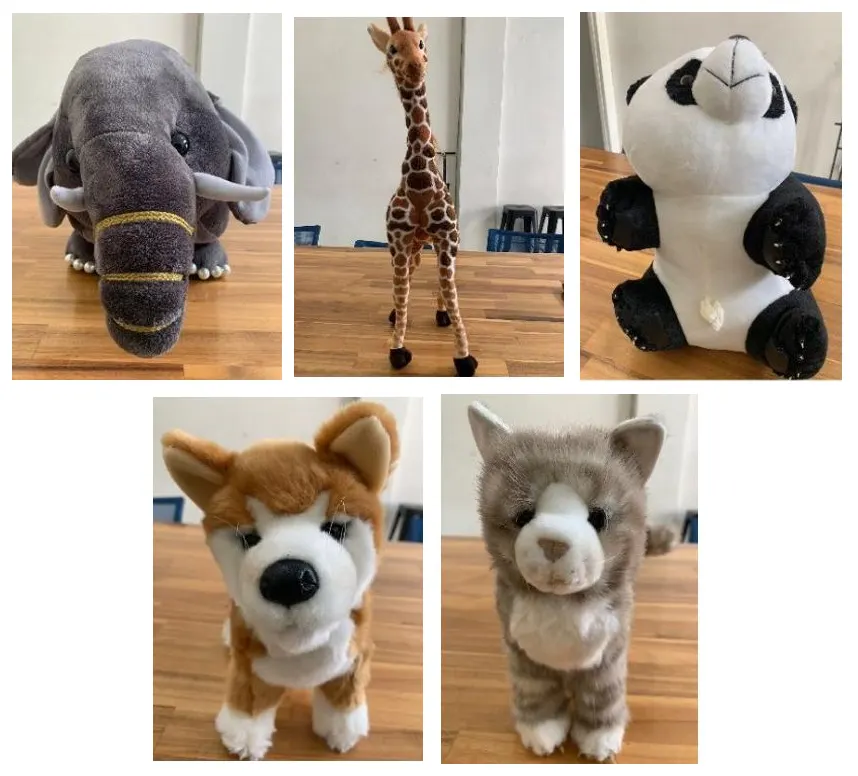
The talking animal dolls in this case are an elephant, a giraffe, a panda, a dog and a cat, each with an audio board set and touch sensors built in. A learner presses any one of 5–8 points on the doll and hears the animal's sound or a Thai narration about that part. We delivered all 5 dolls to Rajamangala University of Technology Thanyaburi for use as learning aids in 2023.
- Industry
- Government
- Year
- 2023
- Scope of work
- Design and assembly of audio board sets with touch sensor pads at 5–8 points per doll, for 5 animal dolls; programming to play 5 sounds per doll according to the point pressed; preparation of user manuals and a separate demonstration video for each doll
Summary
- We delivered 5 talking animal dolls (elephant, giraffe, panda, dog and cat) to Rajamangala University of Technology Thanyaburi for use as learning aids in 2023.
- Each doll has 5–8 touch points and 5 sounds: the animal sound, an overview narration and 3 further narrations on physical features, in Thai.
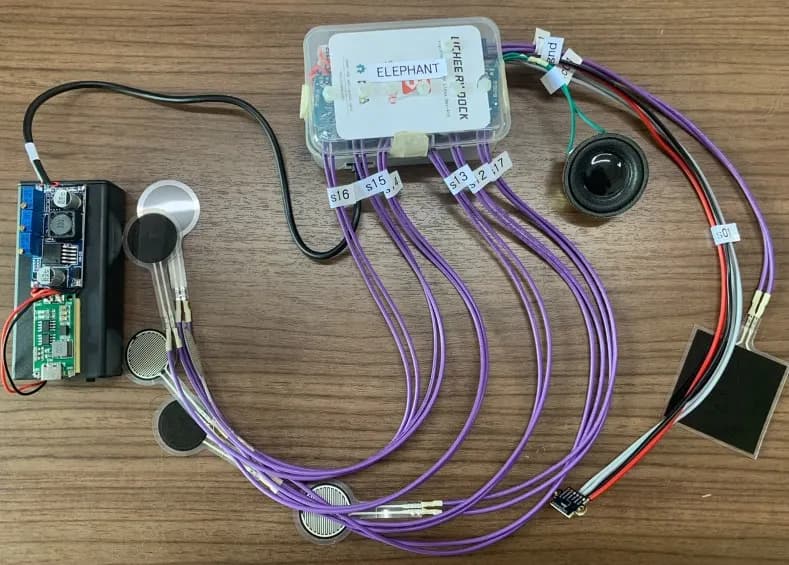
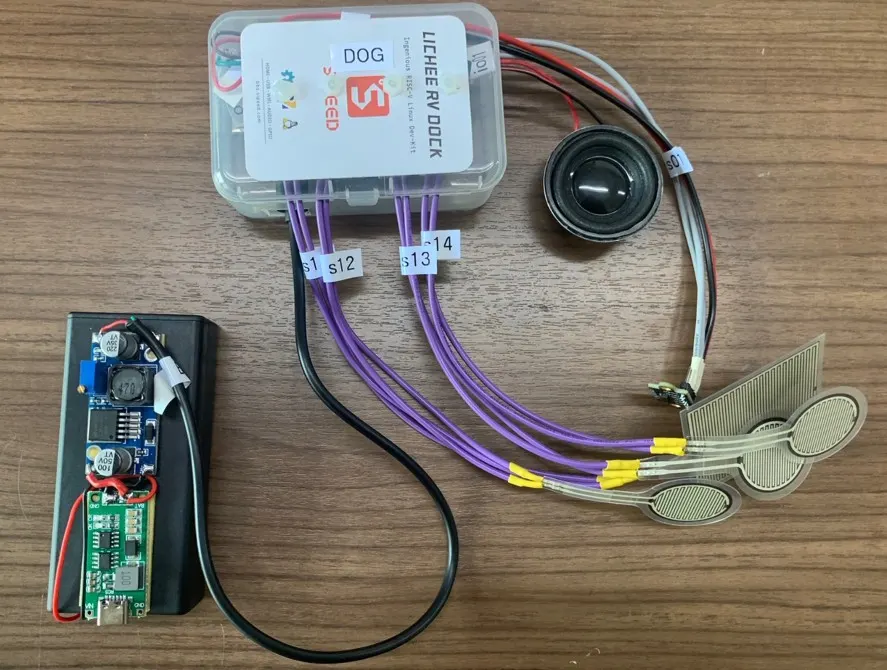
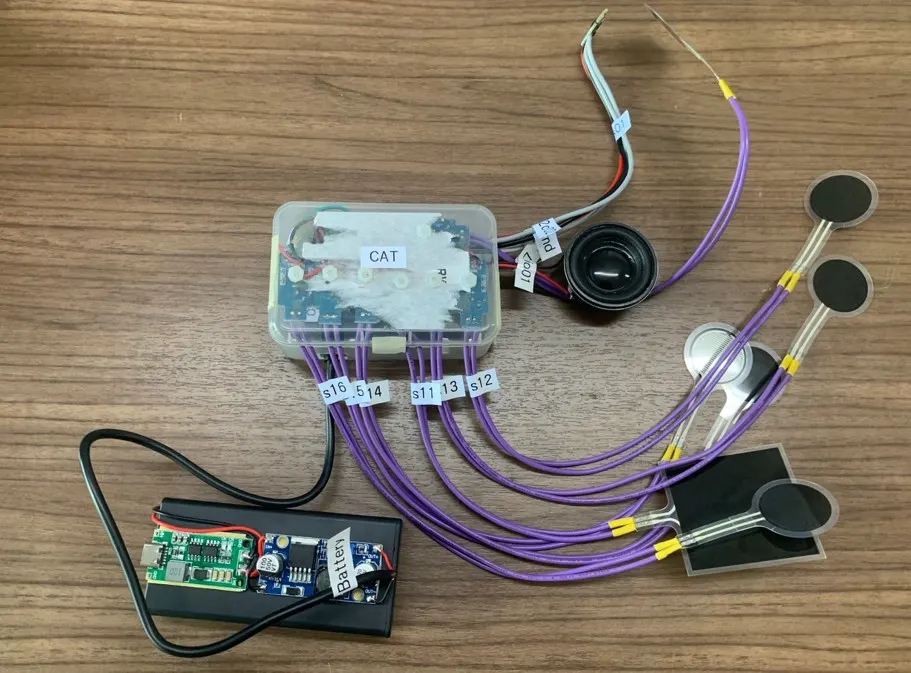
- Every doll uses the same equipment set: a Lichee RV Dock (RISC-V) control board, a speaker, touch sensor pads and a battery pack with switch, all housed inside the doll.
- The dolls are ready to use as soon as the switch is turned on, with no need to connect a computer or the internet.
- Delivered with a manual specifying the sensor positions and narration script for every point, and a separate demonstration video for each doll.
The on-site brief
The university wanted animal dolls that would make the animal's sound or describe, in Thai, the part the learner presses. All of the equipment had to sit inside the doll and run on battery power, and the university had to be able to test it before the dolls were sewn closed.
What we did
We designed an audio board set using the same components in every doll: a Lichee RV Dock control board (a small RISC-V computer board), a speaker, touch sensor pads, and a battery pack with on/off switch. When a learner presses a point, the board plays that point's audio file through the speaker. Each doll has 5 sounds: the animal sound, an overview narration and 3 further narrations on physical features.
- Learner presses a point on the dollBelly, eyes, trunk, legs, body, etc.
- Touch sensor pad5–8 points per doll
- Lichee RV Dock control boardPowered by the battery pack
- Speaker plays Thai narration audio filesAnimal sound / narration
Results
We delivered all 5 dolls in 2023, with a user manual specifying the sensor positions and narration script for every point, and a separate demonstration video for each doll. Users turn on the switch on the battery pack and can press and use the doll straight away, with no need to connect a computer or the internet.
How the brief came about
The brief in this case was to make animal dolls that could give spoken information about the part a learner presses. Rajamangala University of Technology Thanyaburi wanted elephant, giraffe, panda, dog and cat dolls to use as learning aids. When a learner presses different parts, such as the trunk, neck, legs or body, the doll had to make the animal's sound or describe that part in Thai.
A university representative defined the scope of work, while we were responsible for the audio board set, from circuit design and programming through to the user manual.
Requirements and constraints
The main requirement was that all of the equipment had to sit inside the doll and work on its own, as detailed below.
- The board, speaker, sensor pads and battery must be inside the doll.
- Battery powered, with no connection to a computer, server or the internet.
- Each audio file is tied to a position on the animal's body, so each type of doll has different touch points and narration topics.
- The university must be able to test the board set before the doll is sewn closed.
How can a doll talk without connecting to a computer?
Each doll can talk because it has its own audio board set inside. The Lichee RV Dock control board receives the signal from the touch sensor pad and plays the audio file for the point pressed through the speaker. Everything runs on power from the battery pack.
The job's requirement was no connection to external systems, so the board set had to play audio on its own, and every doll uses the same components. The types of doll therefore differ only in the positions of the sensor pads and the audio files. Every wire from the sensor pads carries a code label, showing which point plays which sound.
What is an embedded system?
An embedded system is a small computer built into a device to perform a specific task. In this case it is the control board inside the doll, which receives signals from the sensors and plays the audio file for the point pressed, with no need for a screen or external computer.
- 1
Turn on the switch on the battery pack
Turn the power switch on at the battery pack. The control board inside the doll starts up and waits for a press.
- 2
Press the belly to hear the animal sound
The point on the lower belly of every doll plays the sound of that animal.
- 3
Touch the eyes or nose to hear the overview narration
The doll introduces itself in Thai. For example, the elephant doll says, "I am an elephant, with spreading ears and a tufted tail, tall and large and a fine sight, a long trunk and a pair of tusks…"
- 4
Press other parts of the body to hear about that part
For example, pressing the middle of the elephant's trunk plays the narration on the trunk and tusks, pressing a leg plays the narration on legs and feet, and pressing the side of the body plays the narration on skin.
- 5
Turn off the switch after use
Turn the power switch off at the battery pack to stop operation.
Deliverables
We delivered 5 animal dolls with working press-to-play audio board sets, along with documents and videos for users. The delivered items are as follows.
- 5 audio board sets for the elephant, giraffe, panda, dog and cat dolls. Each set has a Lichee RV Dock control board, a speaker, touch sensor pads at 5–8 points, and a battery pack with on/off switch.
- A program that plays 5 sounds per doll according to the point pressed
- User manual specifying the sensor positions and narration script for every point
- Separate demonstration video for each doll
Topics narrated by each doll (according to the user manual)
| Doll | Built-in sounds |
|---|---|
| Elephant | Animal sound · Overview · Trunk and tusks · Legs and feet · Skin |
| Giraffe | Animal sound · Overview · Neck · Legs and feet · Skin |
| Panda | Animal sound · Overview · Head · Legs and feet · Skin |
| Dog | Animal sound · Overview · Body shape · Tail · Skin |
| Cat | Animal sound · Overview · Body shape · Legs and feet · Skin |
The elephant, giraffe, panda and cat have sensors on every leg, and pressing any leg plays the same narration on legs and feet. The dog has touch points on its back and tail instead.
Confirmed results
The confirmed results are the delivery of all 5 dolls with the user manual and demonstration videos. We delivered all 5 talking animal dolls to Rajamangala University of Technology Thanyaburi in 2023, with a manual specifying the sensor positions and narration script for every point, and a separate demonstration video for each doll.
These dolls were delivered for use as learning aids. There is not yet any data measuring learners' learning outcomes, or comparing results with other learning aids.
What we learned
This work offers 3 principles for embedding electronics in sealed items.
- Start with a touch point table. A table stating where each point sits on the item and which sound it plays is the information used to design the circuit, route the wiring and write the user manual.
- An item that will be sealed must be tested before closing. In this job, the requirement was that the university must be able to test the board set before the doll was sewn closed, and every wire carries a code label, so it is possible to trace back which point connects to which sound.
- Circuit stability must be proven before installation in the item, so the work plan should allow time for circuit stability testing ahead of the delivery date.
How can you apply this approach to your own learning aids?
If you need a touch-based learning aid that plays narration when pressed and must work without connecting to a computer, you can use the same approach as this case: embed an audio board in the item, tie audio files to sensor positions, and run it on battery power. The parts to adjust are the item's size, the number of touch points and the audio content.
Reusable parts and parts that need adapting
| System part | Reusable | Needs adapting when |
|---|---|---|
| Audio board set | The same control board, speaker and battery pack in every item | An item smaller or harder than a fabric doll requires rechecking the installation space and speaker position |
| Touch points | Tying one audio file to one position, and labelling wires with codes | If the number or positions of points differ from this case, a new touch point table is needed before circuit design |
| Audio content | The structure of animal sound, overview narration and part-by-part narration | Content in another language or on another topic requires entirely new scripts and audio files |
| Usage | Turn on the switch and press to use, with no connection to external systems | If you need to collect usage data or update audio remotely, additional connectivity must be designed |
- Prepare the narration scripts and audio files for every point, and define which point plays which sound.
- Plan the work sequence with whoever sews or makes the item, so that there is a period for testing the board set before the item is closed.
- Decide how the switch is turned on and off and how the battery is replaced or charged, because the equipment sits inside the item.
- Agree a clear scope before starting if you may want to add functions later, because doing so affects the circuit, the program and the installation positions in the item.
Read more
Technology used
Frequently Asked Questions
Does the doll need to connect to a computer or the internet?
No. The audio board set runs on a battery inside the doll. Turn on the switch on the battery pack and you can press points on the doll straight away.
What can each doll say?
Each doll has 5 sounds: the animal's sound, an overview narration and 3 further narrations on physical features. For example, the elephant has trunk and tusks, legs and feet, and skin, while the giraffe has neck in place of trunk.
What was delivered?
All 5 dolls with working press-to-play audio board sets, a user manual specifying the sensor positions and narration script for every point, and a separate demonstration video for each doll.
Can this be done with other types of toys or media?
Yes, as custom system development work. We need to look at the item's size, the number of touch points, the audio content and how it will be used before we can confirm the circuit design and scope of work.
What are the price and development time?
There is no standard price or timeframe. Both depend on the number of items, the number of touch points per item and the readiness of the audio files. Contact us to request a quotation and work plan.