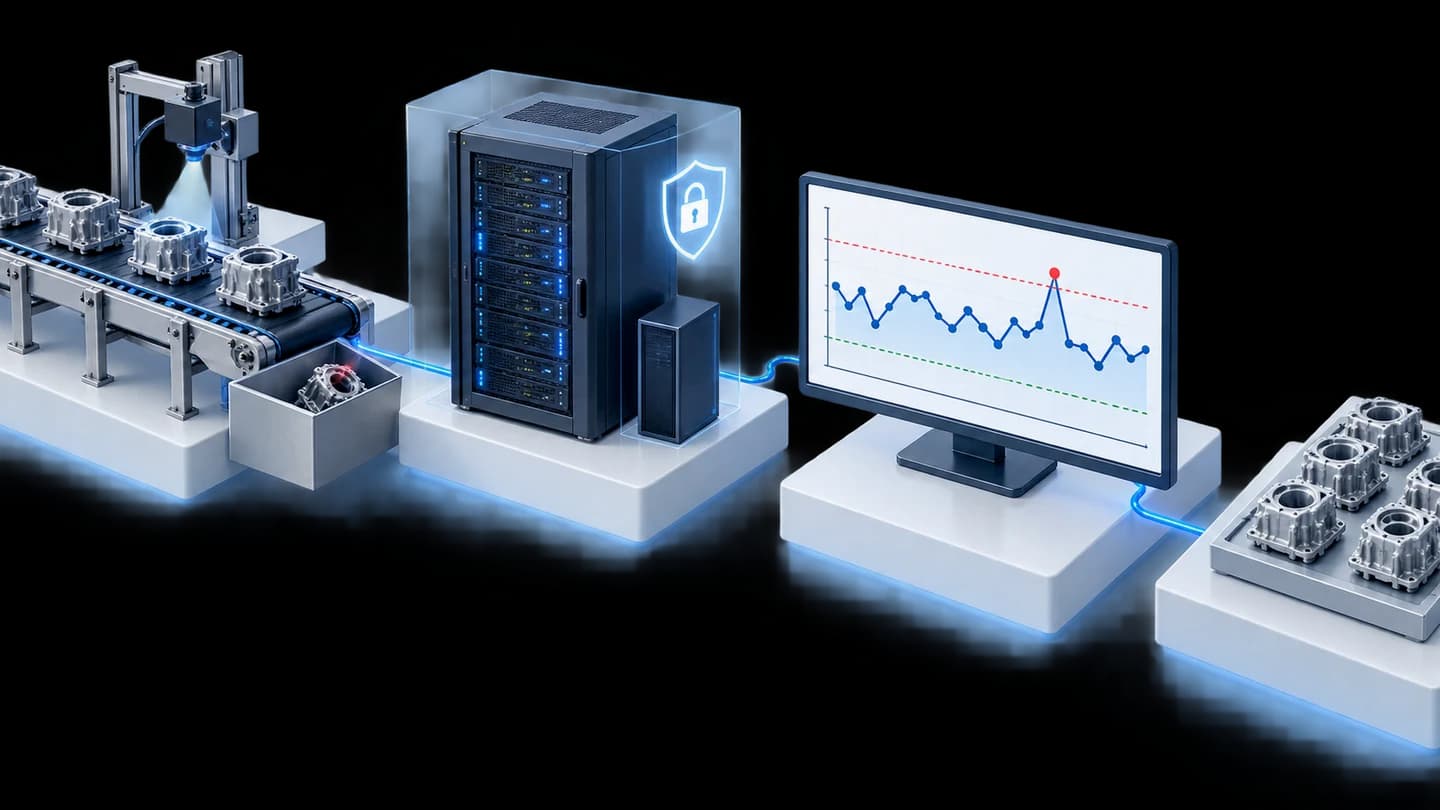





System for sending PLC data and production line video across countries, for automotive parts factories, Cambodia–Thailand.
Customer: Automotive parts manufacturer (Japanese conglomerate)
This case is a pilot system that sends files from the PLC (machine controller) of the production line in the Cambodian automotive parts factory back to Thailand, and allows the Thai team to view the production line video through a web interface. We surveyed the site in B.E. 2562 and installed 1 IoT cabinet and 2 IP cameras in 2563.
- CSV files from PLCs
- 2 IP cameras
- IoT Cabinet + Internet SIM Card
- Thai team views data and video
- Industry
- Automotive
- Year
- 2019–2020
- Scope of work
- Site survey and cross-border network testing (2019), followed by installation of 1 IoT Control Box, 2 IP cameras, a PLC data file transfer system and a web page for cross-border video viewing (2020)
Summary
- This case is a pilot system that sends data files from the PLC of a production line at an automotive parts factory in Cambodia back to Thailand, and lets the team in Thailand view video of the line in operation on a web page.
- In 2020 we installed 1 IoT Control Box and 2 IP cameras on the production line, after surveying the site and testing the cross-border network in 2019.
- The acceptance document dated March 2020 states that 3 software items and 2 hardware items were fully completed.
- This work is a cross-border data and video transfer system, not an AI system for inspecting workpiece quality.
The on-site brief
The team in Thailand needed to monitor the production line at a factory in Cambodia, both the values recorded from the PLC and footage of actual work at the workstation, but all of this data sat on machines on site in another country. Before installation, it was therefore necessary to know whether the factory's internet connection could transfer files and support remote access across the border.
What we did
We split the work into 2 phases. In 2019 we surveyed the site, tested reading values from the PLC and the data logger, tested mobile internet SIMs from 2 carriers and tested cross-border file transfer. In 2020 we installed 1 IoT Control Box, 2 IP cameras, software to send CSV files back to Thailand and a web page for viewing video.
Results
The acceptance document (Exit Criteria) dated March 2020 states that 3 software items and 2 hardware items were fully completed. The team in Thailand could open PLC data files and recorded video of the production line in Cambodia remotely.
How the brief came about
The challenge in this case was to let the team in Thailand see machine data and footage of the production line in Cambodia without waiting for on-site staff to send it. The values recorded by the PLC and the footage at the workstation existed only at the factory, so people in another country found it hard to answer questions about how the line had run in the past.
This work covers cross-border data and video transfer, not an AI quality inspection system. The cameras here record footage for people to review later. They do not use AI to decide whether a workpiece is good or defective.
What is an IoT Control Box?
An IoT Control Box is an equipment cabinet installed beside a production line. It collects data and images from the site and passes them on to users located further away. In this work, the IoT Control Box receives data files from the PLC, stores video from the cameras and sends data over a mobile internet SIM.
Requirements and constraints
The system had to work with the equipment and network on site in another country. The main requirements and constraints are as follows.
- Machine data comes from the PLC and data logger on the line, which had to be tested first to confirm that values could be read.
- Cross-border data transfer uses a mobile internet SIM, so speed and remote access had to be tested on the actual site.
- Positions for the IoT Control Box, cameras, LAN cables and power sockets had to be set within a production line already in use.
- The software runs on the Ubuntu operating system and is developed in Python.
- Images from inside the factory are internal data and are not released to the public.
How does this cross-border data and video transfer system work?
This system sends machine data across the border as files. Values from the PLC are recorded as CSV files on site. The IoT Control Box receives those files and sends them across the border back to Thailand. Video from the cameras is stored in the box, and the team in Thailand views it through a web page.
This approach matches the requirements agreed with the customer: transferring existing CSV files and viewing video online. The customer's system contractor extracts values from the PLC into CSV files, while we handle everything from the IoT Control Box through to the web page. Each team can therefore do its own work, with the CSV file as the handover point.
Deliverables
What we delivered in this work includes both on-site equipment and software, as follows.
- 1 IoT Control Box, designed, built and installed on the production line
- 2 IP cameras: a workstation camera (Single Camera) and a camera with an overview of the line (Overview Camera)
- Software that sends CSV files recorded from the PLC across the border back to Thailand
- Storage of camera video in the IoT Control Box
- A simple web page for viewing video online
Why was this work split into a survey phase and an installation phase?
This work was split into 2 phases because it first had to be confirmed that values could be read from the PLC and that the on-site network could transfer files across the border. Only then was the actual equipment installed. The work sequence was as follows.
- 2019, survey phase: tested reading values from the PLC and data logger, tested mobile internet SIMs from 2 carriers, tested remote access and cross-border file transfer, and set the installation positions for the box, cameras, LAN cables and power sockets
- 2020, installation phase: installed 1 IoT Control Box and 2 IP cameras with the software on the delivery list, followed by acceptance in March 2020
Confirmed results from the acceptance documents
The acceptance document (Exit Criteria) dated March 2020 states that 3 software items and 2 hardware items were fully completed. The team in Thailand could open PLC data files and recorded video of the production line in Cambodia remotely.
During acceptance, users asked for the video files to be sorted by time period. We made this change so that they could find the period they needed more easily. This case has no business performance figures, so we report only results confirmed by documents.
What we learned
This work offers 3 principles for transferring data from overseas factories.
- Test the network and data reading points on site before installing equipment. Cross-border work has variables that cannot be tested from elsewhere, including SIM signal, remote access and space for the box. Separating the survey phase from the installation phase revealed these constraints before equipment was installed.
- The network needs a support plan from the start. In this work, the internet SIM in Cambodia was on a monthly plan, and the project summary recorded this as an issue. If the SIM expires, the system stops sending data.
- Organise data the way users search for it. Remote users mainly review recordings by time period, so video files should be sorted by time from the design stage. In this work, users requested this as an addition during acceptance.
How this approach can apply to your factory
If your factory has a production base in another country and the PLC already records data to files, you can use the same approach as this case: receive the files on site, send them across the border and store video for later review. What needs adjusting is the method of extracting data, the camera positions and the network at your site.
Reusable parts and parts that need adapting
| System part | Reusable | Needs adapting when |
|---|---|---|
| Machine data intake | Receiving CSV files recorded from the PLC into the IoT Control Box | Your machines do not record values to files, so the method of extracting data from the PLC must be agreed first |
| Image recording | Workstation camera and line overview camera, with video stored in the IoT Control Box | The number of workstations or views you need differs from this case, so camera positions must be set afresh from a survey |
| Cross-border network | Transfer over a mobile internet SIM | The factory's IT policy calls for the factory network, or the SIM signal on site is insufficient, so new tests are needed |
| Viewing | Web page for viewing video sorted by time period | You want to see data as graphs or on line-side screens, so display software must be added |
| Division of work | The customer's system contractor extracts values and runs cabling. We provide the IoT Control Box, software and web page. | You have no system contractor on your side, so it must be agreed who extracts values from the PLC and runs the cabling |
Beyond this table, set the data transfer frequency to suit actual use. Sending more often than necessary uses more network capacity with no added benefit.
Read more
- Case study: cycle timing pilot with video on 1 production line
- Case study: mould shot counting and maintenance cycle alert system, Thailand–Cambodia
- Case study: production count and Operation Ratio tracking system across multiple lines
- nimitFlow: a platform for consolidating machine data
- Custom inspection and control system development service
- AI and IoT system installation service for factories
Technology used
Frequently Asked Questions
Is this system an AI Vision system for inspecting workpiece quality?
No. The 2 IP cameras in this work record footage of work at the workstation and an overview of the line for the team in Thailand to review later. They do not use AI to decide whether a workpiece is good or defective.
Is a site survey needed before installation?
Yes. You need to know first whether values can be read from the PLC, whether the factory's internet connection can transfer files and support remote access across the border, and where the box can be placed, cables run and power connected. That is why this work separated the survey in 2019 from the installation in 2020.
Who did what in this work?
The customer's system contractor extracted values from the PLC into CSV files, ran the LAN cabling and mounted the cameras. We designed and built the IoT Control Box, supplied the IP cameras, developed the cross-border file transfer software and built the web page for viewing video.
What kind of internet connection is used to send data across the border?
This work used a mobile internet SIM, with SIMs from 2 carriers tested on site before making a selection. Other factories may be able to use the factory network, depending on each site's IT policy.
What does a system like this cost and how long does it take?
There is no fixed price. It depends on the number of lines, number of cameras, data sources and the network on site. We survey the site first, then prepare a quotation for you.