Camera system for checking lotion bottle cap orientation, for a skincare product manufacturer (FMCG)
This camera inspection system (Machine Vision) measures the rotation angle of the flip cap on a lotion bottle, then decides whether it passes or must be rejected using a 10-degree criterion. We built a prototype test set with an industrial camera and a Medusa processing unit, to the requirements of a skincare product manufacturer in 2017, for a filling line running at up to 120 bottles per minute. The full system for this line consists of several camera sets, lighting and integration with the line.
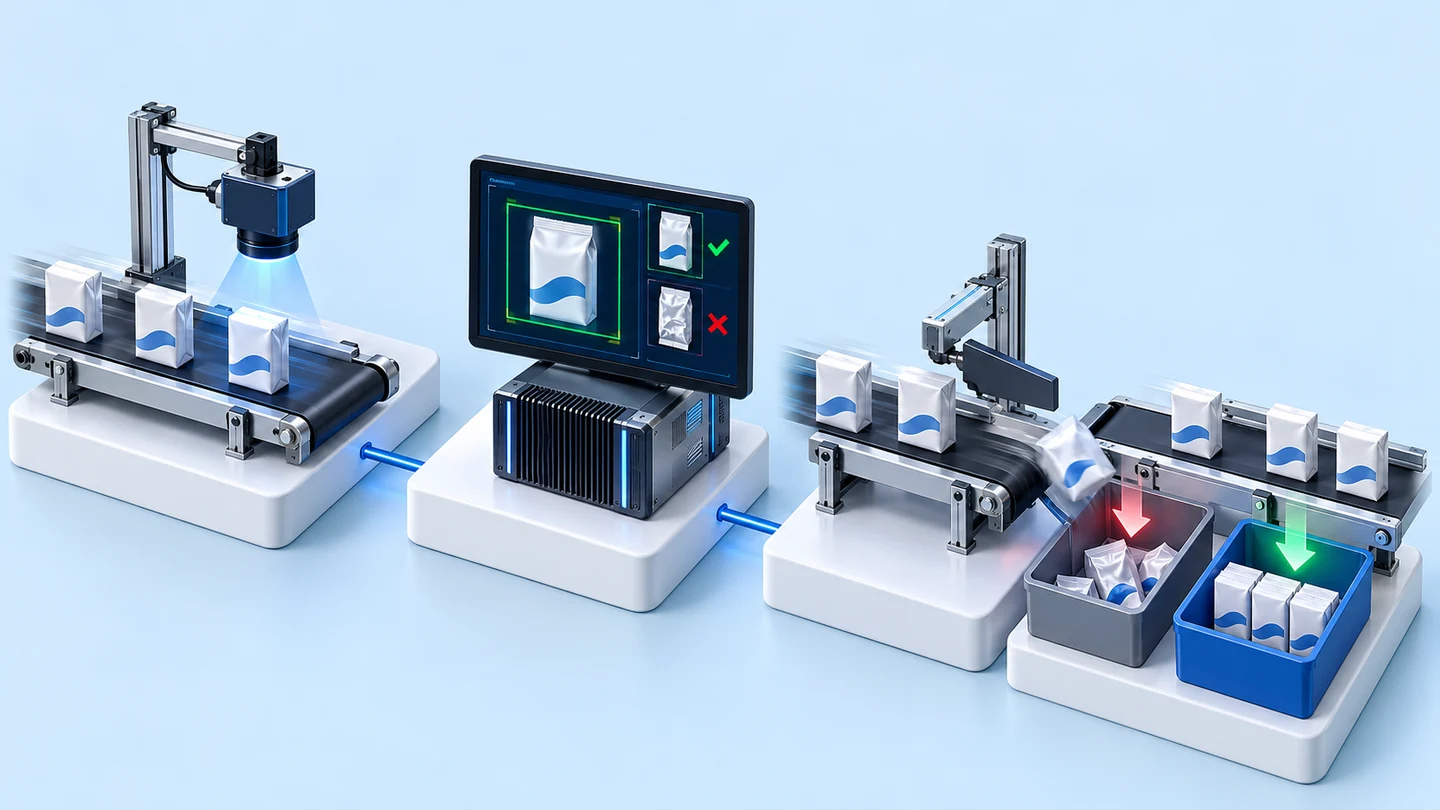
- Industrial camera captures an image of the bottle cap
- Medusa processing unit
- Measures the cap angle against the 10-degree criterion
- Displays pass/reject on the screen
- Industry
- FMCG
- Year
- 2017
- Scope of work
- Camera system for checking flip-top cap orientation on lotion bottles, for a filling line running at up to 120 bottles per minute · Input: bottle cap images from an industrial camera · Processing: a Medusa processing unit runs an image processing program that measures the cap's rotation angle in degrees; a cap tilted by less than 10 degrees passes, at 10 degrees or more it is rejected · Display: pass or reject result on the program screen · Full system for a real line: multiple camera sets, lighting and system integration · What we built and tested: a prototype test rig for cap orientation and sample inspection results for good and defective caps, in 2017
Summary
- This camera system measures the rotation angle of flip-top caps on lotion bottles using image processing. We built a prototype test rig in 2017 and obtained sample inspection results for good and defective caps on the program screen.
- The requirement came from the lotion filling line of a skincare product manufacturer, which runs at up to 120 bottles per minute and uses 2 staff to inspect and correct labels by eye.
- The prototype uses an industrial camera connected to a Medusa processing unit to measure the rotation angle of the flip-top cap using image processing.
- The decision criterion comes from the customer's requirement: a cap tilted by less than 10 degrees passes; at 10 degrees or more it must be rejected.
- The full system for a real line comprises multiple camera sets, lighting and system integration. Label inspection and testing at real line speed must be carried out separately from the cap orientation requirement.
The on-site brief
The customer's lotion filling line runs at up to 120 bottles per minute and uses 2 staff to inspect and correct labels by eye at the packing point. The customer wanted a camera to inspect both the front and back labels and the orientation of the bottle cap, then reject incorrect bottles for correction.
What we did
We built a prototype test rig for the flip-top cap orientation requirement only, using an industrial camera connected to a Medusa processing unit to measure the cap's rotation angle in degrees. A cap tilted by less than 10 degrees passes; at 10 degrees or more it must be rejected. We then summarised the full system components for a real line: multiple camera sets, lighting and system integration.
Test results with real workpieces
The test rig produced sample inspection results for good and defective caps against the 10-degree criterion on the program screen. This result covers the cap orientation requirement on the test rig; label inspection and testing at real line speed must be carried out separately.
How the brief came about
This system uses a camera to inspect lotion bottles in place of inspection by eye at the end of a filling line. This skincare product manufacturer's line runs at up to 120 bottles per minute. At the time, 2 staff inspected and corrected labels by eye at the packing point.
The customer wanted a camera to inspect the front and back labels and to check that the bottle cap faces the right way. Incorrect bottles had to be rejected for correction. Cap inspection was an additional requirement from the customer.
What is a flip-top cap?
A flip-top cap is a bottle cap that opens and closes by flipping up its upper part. If the cap faces the wrong way, the bottle does not meet the packaging standard set by the factory, so the factory must check that the cap faces the right way before sending the bottle to the next step.
Requirements and constraints
The requirements for this work come from the customer's requirements document, which was written for the complete inspection machine. Our prototype took on only the cap orientation requirement. The main requirements are as follows.
- Work with a filling line running at up to 120 bottles per minute
- Inspect front and back labels: missing labels, skewed labels, incomplete print and scratches
- Check that the flip-top cap faces the right way, with the cap tilted by less than 10 degrees
- Reject incorrect bottles for correction, in place of staff inspecting by eye
- Scope of the prototype test rig: cap orientation tested on the test rig; labels and real line speed must be tested separately
How the prototype decides whether a bottle cap faces the right way
The prototype decides cap orientation by measuring the cap's rotation angle in degrees, then comparing it with the 10-degree criterion from the customer's requirement. The customer's criterion is already a number, so an angle measured in degrees can be compared directly with it, giving a pass or reject result that can be checked repeatedly.
- 1
Capture the bottle cap image
Set up the test rig so that the industrial camera sees the bottle cap from a defined distance and angle.
- 2
Process the image
The Medusa processing unit runs an image processing program to find the position and rotation angle of the cap.
- 3
Decide against the criterion
A cap tilted by less than 10 degrees passes; at 10 degrees or more, the bottle must be rejected.
- 4
Display the result
The inspection result shows on the program screen whether the cap passes or must be rejected.
What we built and tested
We built the test rig, tested it with sample bottles and summarised the full system components. The items are as follows.
- Test rig: industrial camera, Medusa processing unit and an image processing program that measures the rotation angle of the flip-top cap
- Sample inspection results for good and defective caps against the 10-degree criterion, shown on the program screen
- Full system components for a real line: multiple camera sets, lighting and system integration with the filling line
Details of test results on real workpieces
The recorded test results are sample images of good and defective caps against the 10-degree criterion. These images show a pass or reject result on the program screen. The documents do not record numerical test results, so we do not report an accuracy figure.
This result covers the cap orientation requirement on the test rig. For use on a real line, testing must be repeated at line speed, label inspection must be tested separately, and a mechanism for rejecting bottles from the line must be designed.
What we learned
The main lesson from this work is to start from numerical criteria and to have numerical test results before deciding to invest in a full system. The principles we have carried forward are as follows.
- Start testing from numerical requirements. A cap angle that must stay under 10 degrees converts directly into a rule in the program, whereas label defects such as skew or scratches need a numerical criterion agreed for each type before they can be tested.
- Prototype results must be recorded as numbers that can be checked repeatedly. Sample images of good and defective work help to show the direction, but an investment decision needs numerical test results, and testing must be repeated at real line speed before use.
- The camera is only one part of an inspection machine. A full system must include multiple camera sets, lighting, system integration and installation, which a test rig testing a single requirement does not yet cover.
How to apply this approach to your filling line
If your line fills products into bottles and needs cap or label inspection, you can use the same approach as this case: test numerical criteria on real bottles at prototype level first, then assess the full system. What needs adjusting is the camera angle, lighting and criteria when your bottle, cap or label differs from this case.
Reusable parts and parts that need adapting
| Part of the work | Reusable | Needs adapting when |
|---|---|---|
| Cap inspection criterion | Measuring the cap's rotation angle in degrees and comparing it with the criterion | Your cap is not a flip-top, or your quality team sets a different acceptable angle from this case |
| Test rig | Industrial camera, processing unit and image processing program | Bottles come in several sizes or colours; camera angle and lighting must be tested with each type |
| Label inspection | The approach of defining numerical criteria before testing | You need to inspect front and back labels; more cameras must be added and criteria designed for each defect type |
| Bottle rejection | Pass or reject result from the program | You need to reject bottles from a real line; a rejection mechanism must be designed and tested at your line speed |
- Prepare pass/fail criteria agreed by your quality team, such as cap tilt angle or label skew distance.
- Prepare sample bottles, both good and defective, covering every size and cap type you actually produce.
- Prepare line speed information and the camera installation area, to plan repeat testing on site before handover.
Read more
- Case: AI camera that inspects and counts plastic bottle caps, with an approach for air rejection of defective caps
- Case: prototype camera-based plastic cap inspection machine, with air blow-off to reject defective caps from the conveyor
- Case: camera system for inspecting glue seams at the inner can seam and the can opening
- Consulting and system design service: build a prototype before investing
- Article: How AI Vision Inspection differs from inspection by eye
- Article: Choosing an AI inspection camera: off-the-shelf Task Cam or custom-built Machine Vision
Technology used
Frequently Asked Questions
What more must be tested before use on a 120 bottles per minute line?
The prototype test rig checks cap orientation on the test rig, not on a running line, so testing must be repeated at real line speed. If front and back labels also need inspecting, more cameras must be added and the criteria for each defect type defined as numbers. If bottles need rejecting from the line, a rejection mechanism must also be designed.
How does the camera decide that a bottle cap faces the wrong way?
The image processing program measures the rotation angle of the flip-top cap in degrees. A cap tilted by less than 10 degrees passes; at 10 degrees or more it must be rejected. This criterion comes from the customer's requirement.
Can it also inspect bottle labels?
The customer's requirement included front and back label inspection, but the prototype in this case tested cap orientation only. Label inspection needs additional camera angle and criteria design, and must be tested with real sample bottles before it can be confirmed.
Can this prototype reject bottles from the line by itself?
The prototype shows a pass or reject result on the program screen. The documents we found do not confirm a mechanism for rejecting bottles from the line. If you need to reject bottles from the line, a rejection mechanism must also be designed and tested at real line speed before use.
What do I need to prepare to start testing like this?
Prepare numerical inspection criteria, sample bottles both good and defective, and information on line speed and installation area. We will assess this and then propose a prototype test plan with a quotation.