




Moving an 11-line production data website to a central server for an automotive parts manufacturer in Thailand
Customer: Automotive parts manufacturer (Japanese conglomerate)
We moved an automotive parts manufacturer's DTS production data website in Thailand from a line-side machine to the factory's VMware server after IT separated the office and production networks. The central website continued receiving data from 11 lines and provided a line selector to access KPI pages through one entry point. The customer signed acceptance in May 2023.
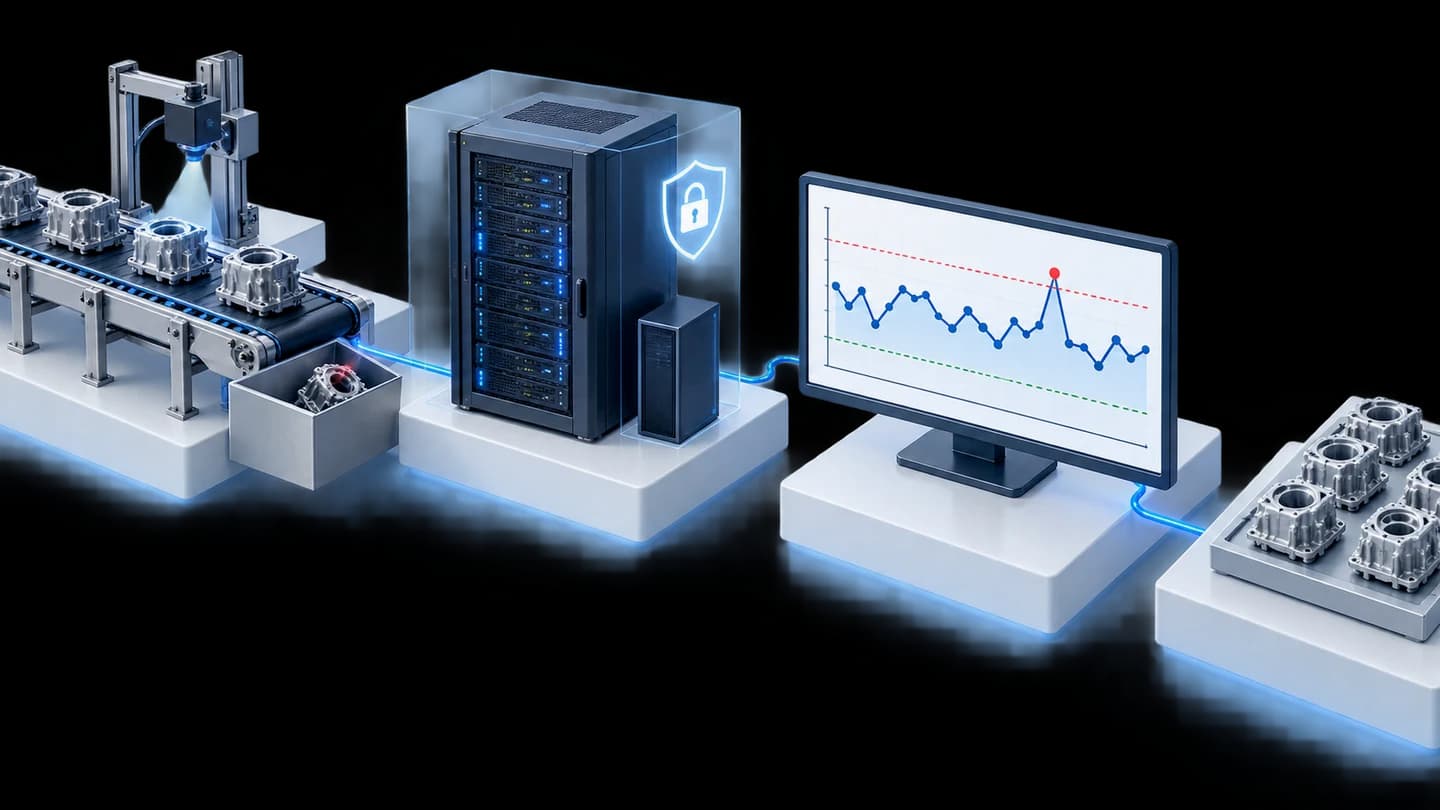
- Client machines on 11 production linesProduction data + Baratsuki KPI pages
- Factory VMware serverWindows Server + IIS + MS SQL Server
- DTS websiteLine selection page + Reverse Proxy
- Office usersAccess through the central server as a single channel
- Industry
- Automotive
- Year
- 2022–2023
- Scope of work
- Move the DTS web to a virtual machine on the customer's VMware server (Windows Server, IIS, MS SQL Server) to receive data from client machines on 11 production lines; build a line selection page to open Baratsuki KPI through DTS as a single channel; provide project documents; and additional work in late 2023 to configure an IIS Reverse Proxy with an SSL certificate
Summary
- We moved the DTS production data website of an automotive parts manufacturer in Thailand to the factory's VMware server, within a scope of 11 production lines.
- The challenge came from a security policy that separated the office network from the production lines, so office computers could no longer open systems directly on line computers.
- The line selection page on DTS is designed so that users reach the Baratsuki KPI pages through the central server as a single channel.
- The customer signed acceptance of the work in May 2023, and we also configured a Reverse Proxy with an SSL certificate in late 2023.
- The customer's IT department set the IP Addresses, ports and installation rights, so the network work had to be planned jointly from the start.
The on-site brief
The factory's IT department separated the office network from the production line network under its security policy, so office computers could no longer open the DTS web and the Baratsuki KPI pages on line computers. The customer's digital transformation (DX) team wanted to access production data from every line through a single central server, to analyse losses in the production process.
What we did
We moved the DTS web to a virtual machine on the factory's VMware server and adjusted the IP Addresses so it could still receive data from 11 production lines as before. We then added a line selection page on DTS so users can choose a line and open its Baratsuki KPI page through the central server. The server work was done together with the customer's IT department, which set the IP Addresses, ports and installation rights.
Results
The customer signed acceptance of the work in May 2023. In late 2023, together with the customer's IT department, we also configured IIS as a Reverse Proxy with an SSL certificate, so that production line KPI pages can be opened through an HTTPS domain name.
How the brief came about
The challenge in this case was to let office users open production data again after the factory separated its office network from its production line network. The separation was made through an iDMZ firewall (a buffer network zone between the office and the production lines), in line with the IT department's security policy.
Before the separation, the DTS web (Datasystem, the factory's production data website) and each line's Baratsuki KPI page were located on computers in the production lines. Office users opened these pages directly from the line computers. After the separation, the old way of access no longer worked and breached the IT department's policy.
Requirements and constraints
The new system had to work under the factory's network policy. The main requirements and constraints were as follows.
- DTS on the server must still receive data from client machines on 11 production lines as before
- Users must reach the Baratsuki KPI pages through DTS as the single channel, without connecting directly to line computers
- The system must be installed on Windows Server, IIS and an MS SQL Server database on the customer's VMware server
- The customer's IT department sets the IP Addresses, ports and installation rights on the server
Why move the existing website to a central server instead of opening access to the line computers?
Because direct access to line computers breaches the factory's security policy, whereas the central server is a point the IT department can control. The line computers still collect data as before. What changes is where the website is located and the route users take to reach it. The main steps of this approach are as follows.
- 1
Move DTS to the VMware server
Install the DTS web on a virtual machine on the factory's VMware server, using Windows Server, IIS and an MS SQL Server database, instead of keeping it on a line computer.
- 2
Receive data from production lines as before
Adjust the IP Addresses so that client machines on 11 production lines send data to DTS on the new server.
- 3
Select a line, then open its KPI page
The line selection page on DTS lets users click the line they need, then opens that line's Baratsuki KPI page in a new tab, to view and manage data through the central server.
Deliverables
The deliverables are divided into the main work accepted by the customer and the additional configuration work afterwards. The items are as follows.
- Main work: the DTS web on a virtual machine on the factory's VMware server, with a line selection page
- Main work: project documents
- Additional work: configuring IIS as a Reverse Proxy with an SSL certificate, so that production line KPI pages can be opened through an HTTPS domain name, and a configuration guide
What is a Reverse Proxy?
A Reverse Proxy is an intermediary server that receives requests from users and forwards them to destination machines behind it. Users therefore open web pages through the central server at a single point.
Work steps
This work ran from late 2022 to late 2023. The sequence was as follows.
- Late 2022: the customer summarised the network situation and goals, and we then prepared a requirements document for the web app
- May 2023: DTS installed on the central server, and the customer signed acceptance of the work
- Late 2023: Reverse Proxy configured together with the customer's IT department, using the domain names set by the IT department, and a configuration guide prepared
Confirmed results
The confirmed result is acceptance of the work. An automotive parts manufacturer in Thailand signed acceptance of the move of its production data website to a VMware server, within a scope of 11 production lines, in May 2023. The evidence is the delivery and acceptance document signed by the customer and the Reverse Proxy configuration guide we prepared in late 2023.
This page reports only the delivery and acceptance of the work. It contains no usage figures or business results and does not cover the current usage status of the system.
What we learned
The main lesson from this work is that network tasks with the IT department determine the project timeline. The principles drawn from this work are as follows.
- When the IT department sets the IP Addresses, ports and installation rights, the work plan must include the IT department's steps from the start, and the team should include a network specialist
- When line computers can still collect data normally, fix the access route first and keep the existing data collection method in the line
- A single entry point must start from a complete list of machines. Every line needs a name, an IP Address and the name used to open its web page, so that the configuration of each line can be checked item by item
Can you use this approach in your factory?
Yes, if your factory has separated its office network from its production lines and existing systems on line computers cannot be opened from the office. The reusable part is moving the existing website to a central server and having users enter through a single entry point. What needs adapting depends on your servers, existing systems and network policy.
Reusable parts and parts that need adapting
| Part of the work | Reusable | Needs adapting when |
|---|---|---|
| System location | Move the existing website to a virtual machine on the factory's central server | Your factory does not yet have a VMware server or central server, so a location for the system must be prepared first |
| Server software | Windows Server, IIS and MS SQL Server | Your existing system uses a different type of web server or database, so compatibility must be checked before the move |
| Receiving data from lines | Adjust the IP Addresses so that line computers send data to the new server | Line computers send data by another method, so the actual data route must be surveyed first |
| Opening each line's web page | Line selection page and Reverse Proxy | Your line systems have no web page, so another display method must be chosen |
| Rights and policy | Let the IT department set the IP Addresses, ports and installation rights | Your network policy differs from this case, so agreement with the IT department is needed before designing the data route |
Before starting, please also check the following.
- Whether other functions of the existing system, such as sending email, can still use the same ports after the network move
- Whether the acceptance criteria have been clearly agreed with the parties concerned
Start with the current network diagram
A network diagram showing which machines are on the office side, which are on the production line side and where they pass through the firewall is the first piece of information we use to design the new data route.
Read more
- Custom system development service
- Data integration and AI development services for organisations
- System care and maintenance service
- Case: Data Views screens showing production line status in real time
- Case: web app tracking actual spending against targets by department
- Article: storing factory data on servers in the factory or in the cloud
- nimitFlow: a data connection platform for new projects
Technology used
Frequently Asked Questions
Can the KPI pages be opened over HTTPS?
Yes. In the additional work in late 2023, we configured IIS on the central server as a Reverse Proxy with an SSL certificate and had the server trust the certificates of the line computers. Domain names follow the information set by the customer's IT department. Configuration is done line by line, so the status of each line must be checked separately.
Does the program used in the production line have to be changed?
In this case, the line program was not rewritten, but the IP Address had to be changed and the line computers configured to send data to the new server. The Baratsuki KPI pages remain on the line computers and are opened through the line selection page on DTS.
Who installs the system on the factory's server?
We install and configure it together with the customer's IT department. The VMware server belongs to the customer, and the customer's IT department sets the IP Addresses, ports and installation rights.
Does this system use nimitFlow?
No. This work moved the DTS web already in use at the factory to a central server on Windows Server, IIS and MS SQL Server. If you are starting a new project that needs to combine data from several machine sources, nimitFlow is an option you can consider.
What are the approximate price and timeline?
There is no fixed price. It depends on the number of lines, the existing systems and the network conditions of each factory. Please contact us for a quotation. We assess the work after seeing your network diagram and the list of systems to be consolidated.