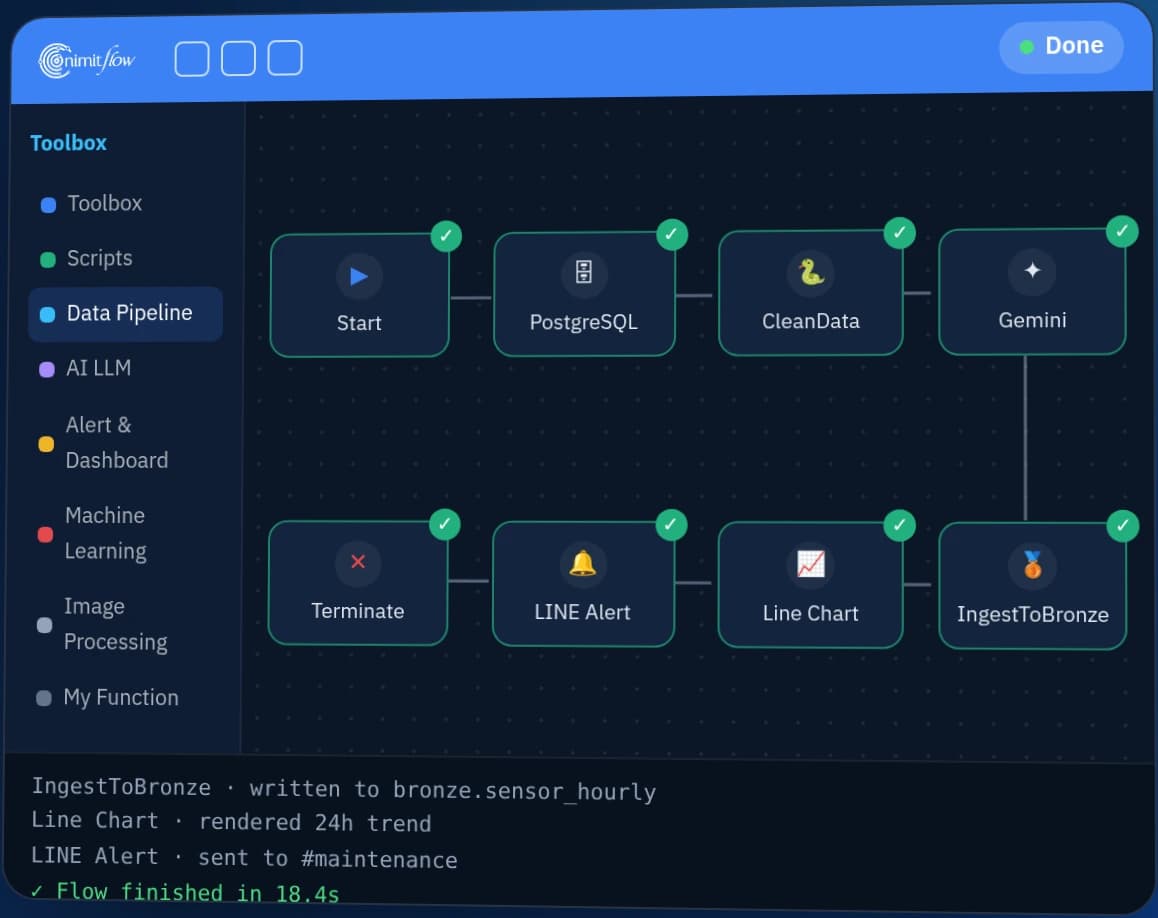





Connect workflows and monitor systems
Manage workflows, view operating status and alert administrators.
- nimitFlow
- Prometheus
- Grafana
Modern Data · Enterprise data repository
Bring ERP/MES, database, file and IoT data into Bronze–Silver–Gold layers for reporting, analytics and AI, with nimitFlow connecting workflows and monitoring the system.
 Connect workflows · Monitor status · Send alerts
Keep data in its original format so it can be reprocessed later.
Clean, deduplicate and structure data according to quality rules.
Summarise data around business needs so teams can use it in reports and analytics.
Access control · Data quality · Catalog · Lineage · Audit Log
IT teams and data teams that need to integrate data from multiple systems
List of source systems, data formats and required access permissions
A Data Lakehouse stores raw data and analytics-ready data in one system. Our Data Lakehouse & Pipeline brings data from your existing systems, files and data-collecting devices into this central repository. Data undergoes quality checks in layers, access can be controlled, and its origins can be traced. The same data can then serve reporting, analytics and AI, including Predictive Analytics and Enterprise KM Chatbot.
Many organisations store data in separate places: ERP/MES databases, Excel files, NAS devices and production-line equipment. Integration often relies on scheduled scripts that are hard to maintain, slowing reports and making figures difficult to trace. Starting an AI project then requires collecting and cleaning the data again each time.
How does a Data Lakehouse differ from a Data Lake and a Data Warehouse?
A Data Lakehouse combines a Data Lake (raw data in any format at low storage cost) with a Data Warehouse (structured tables and fast SQL queries). It stores data in open formats (Parquet and Apache Iceberg) on S3 object storage, avoiding dependence on a single vendor.
Traditional approach
Data Lakehouse
Summary: The same data serves reporting, analytics and AI
Data Lakehouse & Pipeline works in 5 steps: connect sources, preserve raw data, validate and clean it, prepare it for use, and let users query it. Data-layer software is Open Source, while nimitFlow and Prometheus/Grafana monitor the system.
Connect data sources
Ingest SQL databases (such as Oracle, PostgreSQL and MS SQL), APIs, files, Google Sheets and IoT devices using Apache Airflow for batch jobs and Apache Kafka for continuous streams or source-change capture (CDC).
Bronze — preserve raw data
Preserve data in its source format (Schema-on-read), so it can be reprocessed when rules change.
Silver — validate and clean
Apache Spark validates, cleans and deduplicates data according to Data Quality Rules, then stores it in Iceberg tables.
Gold — data ready for use
Aggregate and enrich data for business needs, ready for BI reports, analytics and AI/ML.
Use data and monitor the system
Users query data with SQL through Trino / Dremio and connect Tableau, Power BI or Jupyter Notebook. IT teams monitor all layers in one view using nimitFlow with Prometheus/Grafana and receive LINE or email alerts.
Storage is separate from Compute, so capacity and processing resources can scale independently with workload without stopping the system. Iceberg tables support ACID updates (each transaction is committed fully or not at all), Time Travel to earlier data states, and schema changes without rebuilding tables.
In this architecture, data resides on your organisation’s servers (On-Premise), and users can access only what their roles permit. Centralised data needs tighter access control, so authentication, authorisation, encryption and access logging are designed in from the start, as listed below.
Example role-based permissions (tailored with you during design)
| Role | Bronze | Silver | Gold |
|---|---|---|---|
| Data Engineer | Read/write | Read/write | Write through the pipeline |
| Data Analyst / BI | No access | Read department data only | Read |
| Data Scientist | Read (personal data masked) | Read | Read |
| Auditor / Compliance | Read audit logs | Read audit logs | Read + Lineage |
A Data Lakehouse suits organisations with data across many systems that need reports based on the same data and must keep it in-house. It may be unnecessary when data volumes or sources are limited; a central database or nimitFlow may be enough to start. If machines do not yet collect data, you first need collection devices or a source system, such as InSensor for sensor data. We assess data volumes and source-system counts before proposing an approach.
Suitable and unsuitable uses for a Data Lakehouse
| Job | Is a Data Lakehouse suitable? | Reasons or things to do |
|---|---|---|
| Data spans multiple systems (ERP, MES, databases, files), and reports need a shared dataset. | Suitable | Consolidate data centrally and validate quality in layers before reporting. |
| Data must stay in-house with fine-grained permissions and auditable access. | Suitable | Deploy On-Premise, manage permissions with Ranger and keep audit logs. |
| Prepare production, machine and quality data for Predictive Analytics or AI. | Suitable | AI workloads use validated Gold-layer data. |
| IT needs an open-standards system without dependence on one vendor. | Suitable | Data stored as Parquet / Iceberg using the S3 API standard |
| Data volume is small or there are few sources. | May not be needed yet | Start with a central database or nimitFlow, then expand. |
| Data policies require cloud deployment. | Assess per project | This architecture is designed for in-house servers. |
| Machines do not yet collect data. | Collection devices or a source system are needed first. | A Data Lakehouse receives data from existing systems or devices; it does not read machine signals directly. |
We have integrated production and management data for an automotive parts manufacturer in Thailand and prepared transaction data to train Machine Learning models for a Thai financial-sector organisation. No project using the Data Lakehouse architecture shown here has been delivered yet; it comes from our latest proposal. The work below is therefore related data experience, not delivered Data Lakehouse projects.
Read our data project case studies
IT security policies determine where data resides and which networks can access it. In both data-integration projects for the automotive parts manufacturer, the customer’s IT team defined network settings, installation permissions and cloud-system security checks. Design therefore needs IT involvement from the start.
Figures imported from existing reports must be checked against the originals before users rely on them for decisions. Data validation and user-feedback changes continue after the first delivery and need to be planned from the outset. AI work starts with cleaning data before model training, and new systems should be separated from core operations to avoid service disruption.
Your Data Lakehouse project starts by reviewing source systems and security policies with your IT team. We then build a Bronze-to-Gold pipeline using a pilot dataset. You compare Gold-layer figures with your existing reports, and only expand to other sources once the figures match.
We plan Data Lakehouse projects in 5 stages: detailed design; server and platform installation; data integration and security configuration; testing and go-live; and post-launch support with knowledge transfer. Intensive post-launch support (Hypercare) and knowledge transfer can be included in the agreed scope so your IT team can take over operation.
Detailed design
Confirm requirements; prepare high- and low-level designs (HLD/LLD), a permissions matrix, data-retention policies and a test plan.
Install servers and the platform
Install hardware and Linux, harden security against the CIS Benchmark, then install platform components.
Integrate data and configure security
Build a Bronze-to-Gold pipeline with a pilot dataset, connect SSO, and configure permissions, encryption and auditing.
Test and go live
Run user acceptance testing (UAT), resolve defects, then deploy to production.
Post-launch support and knowledge transfer
Define the post-launch support period and workshops for each team in the agreed scope.
Handover documents are in Thai, retaining English technical terms: system designs, installation guides, administration manuals, daily-operation guides, monitoring manuals, alert-configuration documents, troubleshooting guides, UAT records, As-Built documentation and training materials.
Example timeline
Our latest proposal outlines approximately 22 weeks, with 60 days of post-launch Hypercare that may extend beyond that plan, and at least 30 hours of knowledge transfer. Actual duration depends on the number of sources and the readiness of source systems.
| Platform name | Enterprise Data Lakehouse Platform (no model code — configured per project) |
|---|---|
| Architecture | Open Data Lakehouse with Medallion layers (Bronze–Silver–Gold), separating Storage and Compute |
| Table / file formats | Apache Iceberg (ACID, Time Travel, Schema Evolution) · Parquet |
| Storage | MinIO (S3-Compatible) with Erasure Coding and Object Versioning |
| Data ingestion | Apache Airflow (Batch: JDBC / API / files) · Apache Kafka (Streaming, CDC) |
| Processing | Apache Spark with a Data Quality Framework |
| Data querying | Trino / Dremio — SQL for BI and analytics |
| Catalog / Lineage | OpenMetadata — Data Catalog, Business Glossary and column-level Lineage |
| Security | Apache Ranger (row/column RBAC, Masking) · Keycloak (SSO, MFA) |
| Encryption | AES-256 at rest · TLS 1.2 or later in transit |
| System monitoring | nimitFlow + Prometheus / Grafana — LINE / email alerts |
| Installation Format | On-Premise on your organisation’s Linux servers |
Components follow the architecture in Inspektion’s latest project proposal (July 2569 BE). Hardware sizing and components are tailored to each organisation’s data volume and project scope.
Your organisation’s data journey
Follow the flow in order, then explore each technology’s role below. Data quality rules, access controls and status monitoring connect every layer.
Connect workflows · Monitor status · Send alerts
ERP/MES, SQL databases, files, APIs and IoT
Data from multiple systemsAirflow handles scheduled ingestion; Kafka handles continuous ingestion and changes from source systems.
Batch · Streaming · CDCSpark validates and transforms data, organising Iceberg tables on S3 storage.
Bronze → Silver → GoldQuery with SQL through Trino / Dremio, then connect to BI reports, analytics and AI.
Reporting · Analytics · AInimitFlow connects workflows and monitors the overall system with Prometheus / Grafana, while Airflow, Kafka and Spark handle their respective data-processing roles.
Keep data in its original format so it can be reprocessed later.
Raw ERP / IoT dataClean, deduplicate and structure data according to quality rules.
Validated, connected dataSummarise data around business needs so teams can use it in reports and analytics.
Datasets for BI / AIAccess control · Data quality · Catalog · Lineage · Audit Log
Components follow the proposed architecture. Selection and sizing depend on your data sources, workload and organisational policies.
Manage workflows, view operating status and alert administrators.
Ingest data in batches or continuously, then validate and transform it before use.
Separate storage from compute, using open table and data file formats.
Query data with SQL and connect it to reporting interfaces or analysts’ tools.
Build a data catalog, business glossary and data lineage.
Connect organisational accounts, set permissions, mask data and audit access.
nimitFlow, APIs and team interfaces
Spark and Trino resources separated from storage
S3-compatible storage with a backup plan
This is a proposed project architecture, not a depiction of a system already delivered to a customer. Server sizing, backups and High Availability must be designed and tested against the actual scope.
Data-layer software is Open Source; nimitFlow, hardware, operating systems and services are priced according to the quotation.
Data-layer software is Open Source; nimitFlow licensing follows the quotation. Costs cover hardware, operating systems, installation, data integration and support within the agreed scope.
Start with a discussion of your needs. We review source systems, data formats and your organisation’s security policies, size the system around data volumes, then propose a scope of work and quotation.
No. Data Lakehouse extracts data through databases (JDBC), APIs, files or CDC, so your existing ERP/MES can continue operating as usual.
Data-layer software has no annual licence fee because it is Open Source. nimitFlow, used for monitoring, is Inspektion software and is priced by quotation. Main costs are hardware, operating systems, nimitFlow licensing, installation, data integration and system support.
No. This architecture is designed for your organisation’s servers (On-Premise). If data policies require Cloud use, we assess each project against your organisation’s policies and budget.
Down to individual rows. Apache Ranger supports table-, column- and row-level permissions, column-level personal-data masking, and audit logs of every access.
Yes. Data-layer software is Open Source and data uses open formats. Role-based knowledge-transfer workshops and Thai manuals can be included in the scope. After the handover, your IT team can operate and extend the system independently.
It depends on source count, data volume and required hardware. Contact our team for scoping and a quotation. Our latest proposal example planned approximately 22 weeks, with post-launch support potentially continuing beyond that schedule.