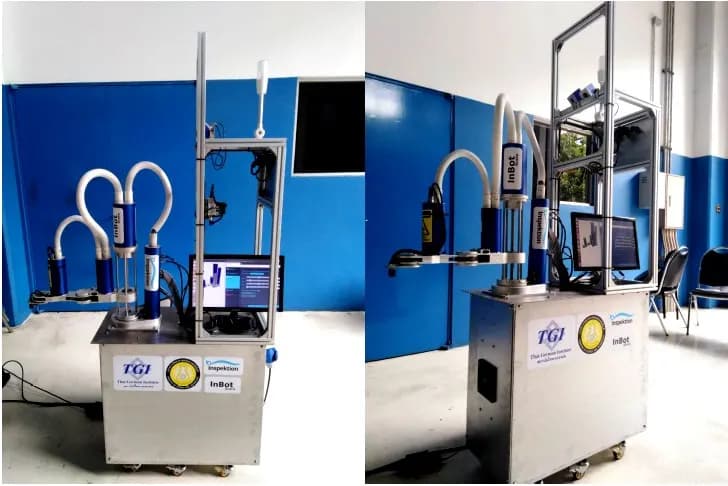
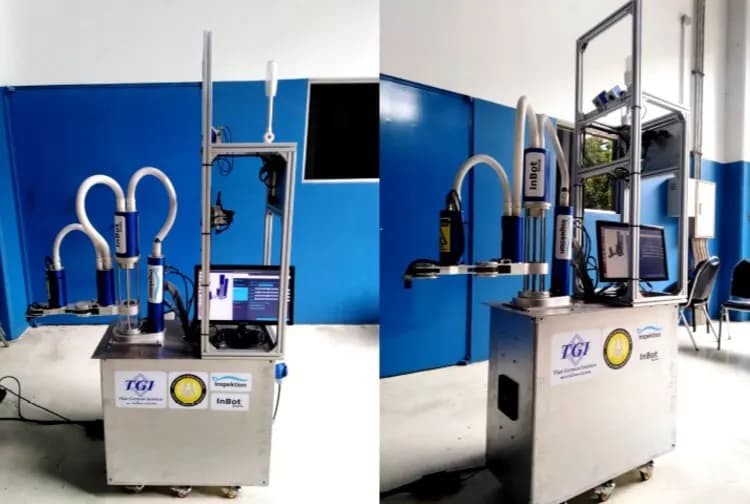
Prototype machine for testing camera, lens, and lighting combinations for Machine Vision (MVDeep) under a Thai government project
Organisation: Thai-German Institute (TGI)
MVDeep is a prototype machine that tests which camera, lens, and lighting combinations suit camera-based color-shade inspection. We designed and built it under a government machinery prototype development support project in fiscal year 2562 B.E. A set of 3 robotic arms switches equipment around the workpiece; the machine then calculates Cpk and reports the top 5 equipment combinations.
- Industry
- Government
- Year
- 2019–2020
- Scope of work
- Design, build and test 1 MVDeep prototype machine (XY Table, 3 robotic arm sets, NVIDIA Jetson Xavier board running ROS) against the target of producing no fewer than 100 Cpk reports per 8 hours, together with a work plan report, a progress report, a final report, an operation and maintenance manual, and transfer of operating knowledge to the participating company, under the machinery prototype development support project, fiscal year 2019
Summary
- MVDeep is a prototype machine that we designed and built under a government machinery prototype development support project in fiscal year 2019, to test which camera, lens and lighting combination suits colour shade inspection.
- 3 robotic arm sets switch the cameras, lights and lenses around the workpiece. AI groups colour shades from images, then a statistics module calculates the Cpk of each equipment combination.
- The machine produces PDF reports of the 5 equipment combinations with the highest Cpk values and can send the reports to the Cloud.
- The final report records that the machine met the target of producing no fewer than 100 Cpk reports per 8 hours, and we presented the work for final acceptance in July 2020.
- The delivered set has preset slide rail positions and pick-up positions. It does not yet have a system for finding camera and lighting positions automatically.
The on-site brief
The Thai private company participating in the project had to try cameras, lenses and lights one set at a time for every Machine Vision (camera-based inspection system) job. Most tests took more than 1 day, some jobs over 1 month, and they required specialists in several fields. As a result, the company could take on fewer jobs than it received. The first task the company wanted addressed was colour shade sorting inspection.
What we did
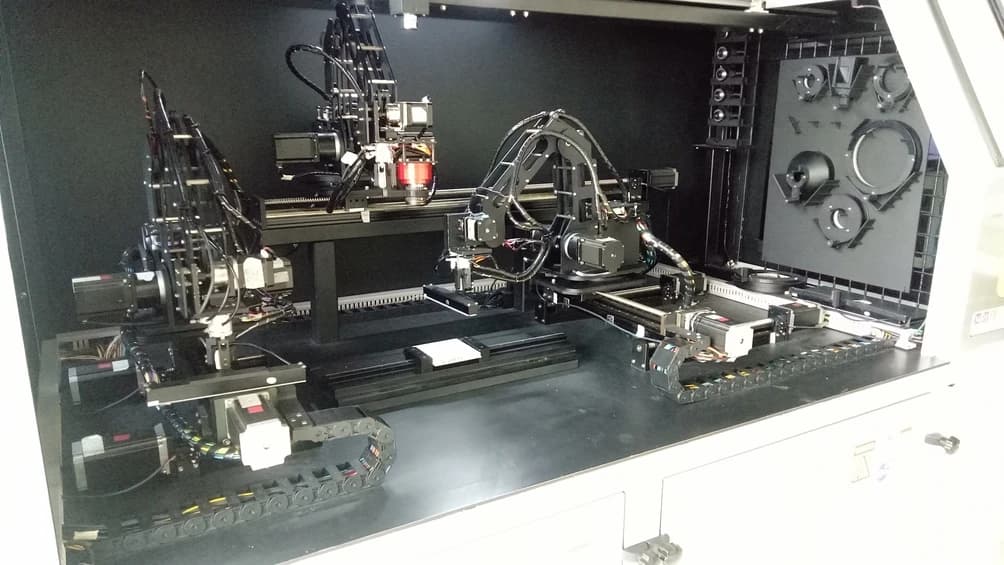
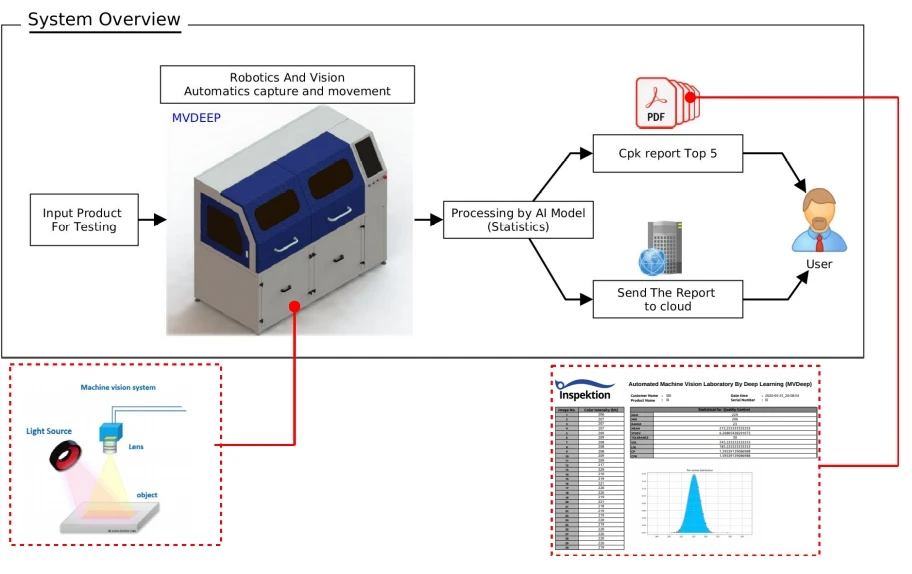
We built 1 MVDeep machine. 3 robotic arm sets arrange the camera, lights and lenses around the workpiece on an XY sliding table, following preset positions. AI groups colour shades from images, then a statistics module calculates the Cpk (process capability index) of each equipment combination. The machine produces PDF reports of the top 5 equipment combinations and can send the reports to a Cloud system.
- Workpiece on the XY TableEnter workpiece details on the screen
- 3 robotic arm setsArrange the camera, lights and lenses
- Machine Vision camera takes images
- NVIDIA Jetson Xavier + ROSAI groups colour shades + calculates Cpk
- PDF report + cloudTop 5 equipment combinations by Cpk
Results
We presented the work for final acceptance in July 2020. The final report records that the machine met the target of producing no fewer than 100 Cpk reports per 8 hours, and that it could send reports to the Cloud. The delivered set still uses preset camera and lighting positions; it does not yet have a system for finding positions automatically.
How the brief came about
The challenge in this case was to reduce the time spent choosing cameras, lenses and lights for camera-based inspection. Whether a Machine Vision (camera-based inspection system) job performs well depends on matching this equipment to the workpiece from the outset. The Thai private company participating in the project did this step by trying equipment one set at a time and checking the results with statistical values.
Most tests took more than 1 day per job, some over 1 month, and required people with knowledge of lighting, imaging, industrial statistics and image processing. As a result, the company could take on fewer jobs than it received. The bottleneck was testing time and the number of people able to do the work.
We developed this machine under a government machinery prototype development support project in fiscal year 2019. The project's full name is Automated Machine Vision Laboratory By Deep Learning (an automatic workpiece inspection machine using an intelligent deep learning camera). The word Laboratory here means a machine for testing equipment combinations on real workpieces, not a classroom.
What is Cpk?
Cpk (Process Capability Index) shows how consistently measured results stay within the specified tolerance range. A higher value means the results are stable and further from the tolerance limits. In this work, Cpk was used to compare which camera, lens and lighting combination gave the most stable shade sorting results.
Requirements and constraints
The machine had to produce no fewer than 100 Cpk reports per 8 hours and summarise the results of every equipment combination as comparable statistical values. Other requirements and constraints are as follows.
- Build 1 prototype machine under a government support project
- Start with colour shade sorting inspection, the first task set by the participating company
- Decide equipment selection by statistical values instead of estimates based on human experience
- The workpiece must be placed on the XY Table inside the cabinet, where space is limited
Why use robots to switch equipment, then decide by Cpk?
We had robots switch the cameras, lenses and lights, then decided by Cpk, because the bottleneck was the time needed to test equipment one set at a time and the small number of specialists. A machine that can repeat tests in the same sequence and summarise every combination by the same criteria allows equipment selection to be based on figures.
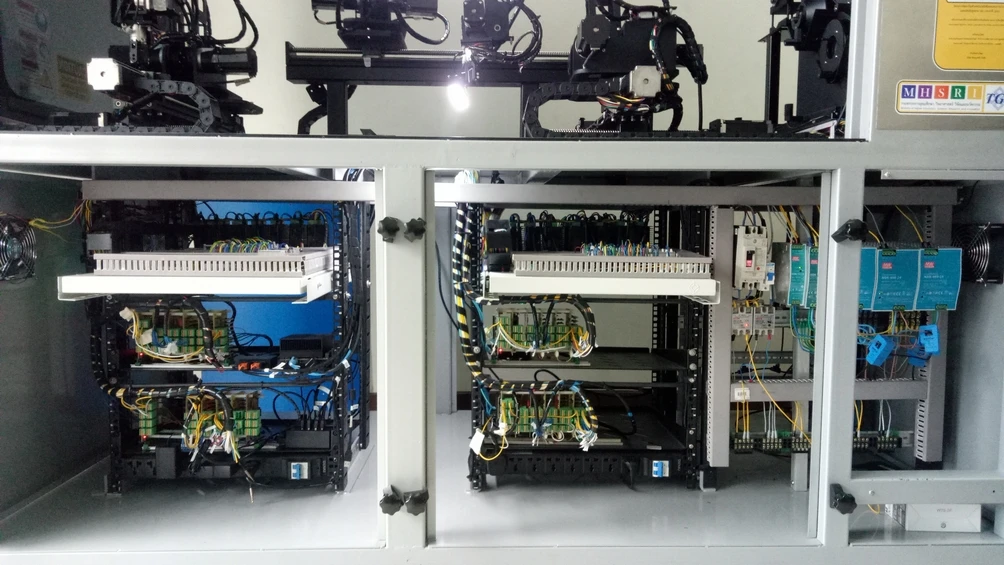
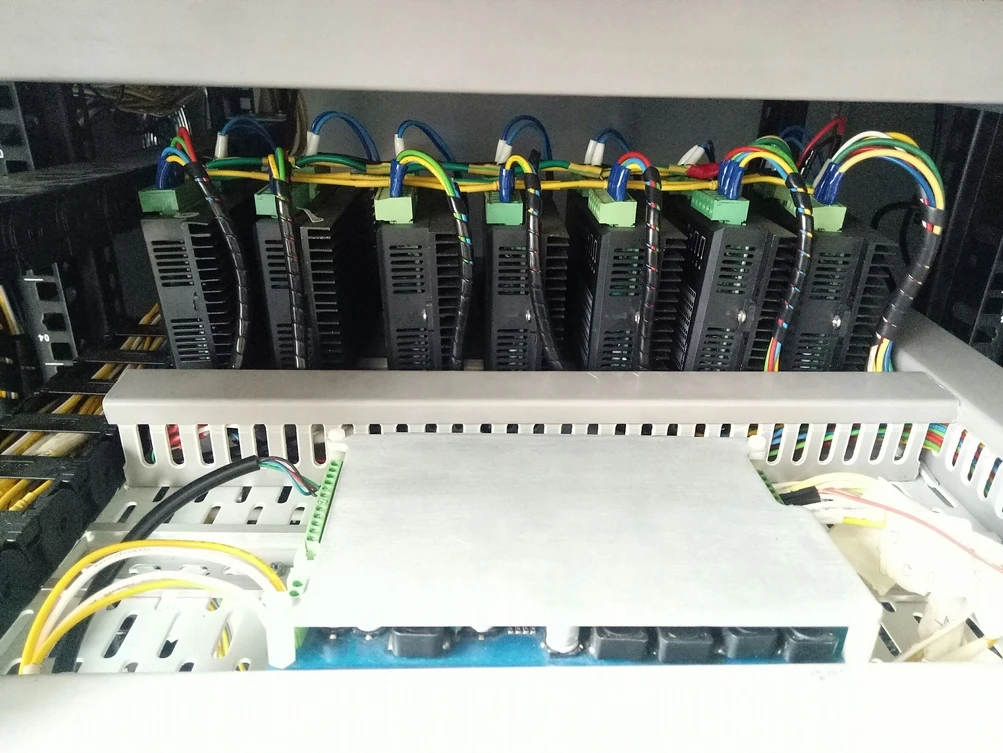
The machine is divided into an upper cabinet for testing and a lower cabinet for the electrical control unit. An NVIDIA Jetson Xavier processing board uses ROS (Robot Operating System, a robot control software suite) to control all the robots. The workflow is as follows.
- 1
Place the workpiece and enter details
The user places the workpiece on the XY Table in the upper cabinet, then selects the inspection type and enters the workpiece details, centre position and size on the machine's screen.
- 2
Robots arrange the camera, lenses and lights
When Start is pressed, the first robotic arm set moves the camera to the centre of the workpiece, takes images, then changes the distance. The other two sets hold the lights and change the lens and light models, so that images are obtained from several equipment combinations.
- 3
AI sorts colour shades and calculates Cpk
AI groups the workpiece's colour shades from images (Clustering means grouping similar data), then a statistics module calculates the Cpk of each equipment combination.
- 4
Produce reports and send them to the Cloud
The machine summarises the 5 equipment combinations with the highest Cpk values in PDF reports and can send the reports to a Cloud system from the machine's program.
Deliverables
We delivered 1 MVDeep prototype machine with software, documents and transfer of operating knowledge. The main items are as follows.
- A test cabinet with an XY Table and 3 robotic arm sets for positioning the camera, holding the lights and changing lenses and lights
- Several types of light: Bar Lights, multi-angle Ring Lights and Coaxial Lights (lighting in line with the lens)
- FA lenses (industrial lenses) with several focal lengths, and telecentric lenses (lenses for measurement work that reduce image size changes with distance)
- Electrical control unit in the lower cabinet, and an NVIDIA Jetson Xavier board running ROS
- Software that takes in workpiece details, groups colour shades, calculates Cpk, produces PDF reports and sends the reports to the Cloud
- A work plan report, a progress report, a final report, and an operation and maintenance manual
Confirmed results from the final report
The project's final report confirms MVDeep's test results in 3 areas: report output speed, sending reports to the Cloud, and cabinet safety. In addition to the test results, this work also delivered documents and transfer of operating knowledge to the participating company.
- Speed: the machine met the target of producing no fewer than 100 Cpk reports per 8 hours
- Report delivery: the machine's program can send reports to a Cloud system
- Safety: the machine has a Safety Sensor and stops when the cabinet cover is opened
- Documents: a work plan report, a progress report, a final report, and an operation and maintenance manual
- Knowledge transfer: we transferred operating knowledge of the machine to the participating company
Limitations of the delivered set
The delivered set works from preset positions. Automatic finding of camera and lighting positions is not yet included in this set. If your work needs this capability, it must be planned, developed and tested as separate work.
What we learned
This work offers 3 principles for selecting equipment for camera-based inspection systems.
- Select equipment by the same statistical criteria for every combination, rather than by looking at images or by human experience. Cpk allows many camera, lens and lighting combinations to be compared on the same basis.
- Start from one clear inspection task. This work started with shade sorting, which made it possible to define clearly how results are measured before extending to other types of inspection.
- Separate what can be repeated from what has to be searched for. Preset positions let the machine repeat tests in the same sequence, while automatic finding of camera and lighting positions is another layer of work that must be developed and tested separately.
How this approach can apply to your work
If you have to select cameras, lenses and lights for several camera-based inspection jobs, you can use the same approach as this case: test several equipment combinations in the same sequence, then compare the results by Cpk. What has to be adjusted is the inspection criteria, the workpiece size and the positioning method, when your work differs from shade sorting.
Reusable parts and parts that need adapting
| System part | Reusable | Needs adapting when |
|---|---|---|
| Equipment selection method | Test several combinations in the same sequence, then compare by Cpk | Your work uses criteria other than shade sorting: the measured value and tolerance range must be defined again |
| Arranging the camera, lenses and lights | Robotic arms that switch equipment according to preset positions | Workpieces come in several types or sizes: positions must be planned for each job |
| Image analysis | Grouping colour shades from images | The task is defect detection or dimension measurement: a new image analysis method must be developed and tested |
| Reports | PDF reports of the top 5 equipment combinations, and sending to the Cloud | Your team needs another report format or destination system |
| Installation space | A test cabinet that combines the robots, camera and control unit in one machine | The workpiece is too large for the XY Table in the cabinet: another method is needed |
- A machine of this kind is for testing to find an equipment combination, not for inspecting workpieces on a production line. Once the combination is chosen, the on-site inspection system still has to be designed separately.
- Prepare electrical power, compressed air and space for opening the cabinet for maintenance
- The robotic arms have many motors, so spare motors should be kept and the electrical system checked at the interval given in the manual (usually 1 check per year)
Read more
- Custom inspection and control system development service
- AI / IoT consulting and system design service
- Case: camera-based workpiece colour shade comparison system
- Case: prototype microscope that measures workpiece dimensions from images, under a government project
- Case: self-learning pick-and-place robot
- Article: How AI Vision Inspection differs from human visual inspection
- Article: choosing an AI inspection camera between off-the-shelf Task Cam and custom-built Machine Vision
Images of the system and how it works
Technology used
Frequently Asked Questions
Can MVDeep be used to inspect workpieces on a production line?
It was not designed for production line use. MVDeep is a prototype machine for testing which camera, lens and lighting combination suits a workpiece, then summarising Cpk in a report. Once the combination is chosen, the on-site inspection system must be designed separately.
Can the machine find camera and lighting positions by itself?
Not in the delivered set. The slide rail positions and tool pick-up positions are predefined. The robot moves the camera to the centre of the workpiece based on data entered by the user, then switches lenses and lighting in the configured sequence.
What equipment does this machine use?
An XY Table, 3 robot arms, Machine Vision cameras, several types of lighting (Bar Light, Ring Light, Coaxial Light), FA lenses with multiple focal lengths and telecentric lenses, and an NVIDIA Jetson Xavier processing board that uses ROS to control the robots.
Is MVDeep a training laboratory?
No. The word Laboratory in the project name refers to a machine for testing combinations of camera, lens and lighting on real workpieces. The scope of work includes transferring operating knowledge to the company participating in the project, but the machine was not built for teaching.
I need a testing machine or a camera inspection system for a factory. How much does it cost?
There is no standard price. The price depends on the workpiece, the inspection criteria and the scope of work. Please send us sample workpieces and your brief to request a quotation.