




The system collects PLC data from casting machines into daily files and sends email alerts for a metal casting factory in Thailand
This system reads operating values from the PLC (machine controller) of metal casting machines through a gateway. nimitFlow records the data in CSV (tabular data) files, 1 file per day, and emails an alert if the connection fails. We installed it at a metal parts casting factory in Thailand in B.E. 2568, covering 2 casting machines with 52 values per machine
- Casting machine PLC2 machines
- Industrial IoT GatewaySends data over Wi-Fi
- nimitFlow server in the factoryStores daily CSV files
- Email alertsFull day's data collected / Unreachable
- Industry
- General manufacturing
- Year
- 2025
- Scope of work
- Install and configure 2 gateways connecting to the PLCs, install the nimitFlow server in the factory, develop 3 Workflows for data collection and alerts, configure remote administration through a VPN, test the system and prepare the user manual.
- Duration
- 2 months
Summary
- This system reads values from the PLCs of 2 metal casting machines through industrial IoT gateways and sends them over the factory Wi-Fi to a nimitFlow server installed in the factory.
- The gateways read 52 values per machine, covering both set values and measured values, and nimitFlow records them as CSV files, 1 file per day, in separate folders for each machine.
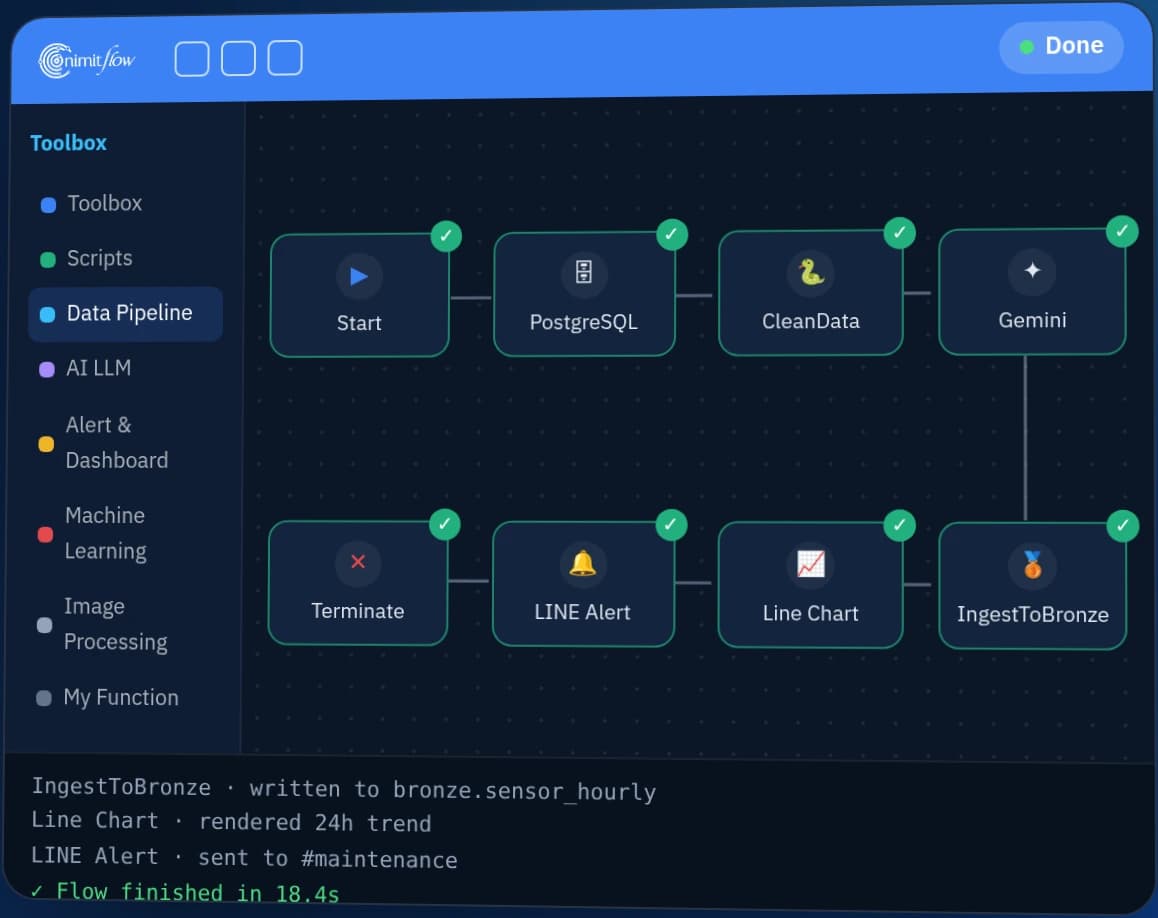
- 3 Workflows in nimitFlow have separate roles: recording data, checking the connection to the gateways and checking that nimitFlow is still running, with email notifications to the administrator.
- The system integration test passed on every item, and the customer's representative signed the acceptance document in August 2025.
The on-site brief
A metal parts casting factory could not extract the operating log (Data Log) from its casting machines. When a machine had a problem, the factory's team therefore had no historical data for investigating the cause. The customer wanted PLC values stored continuously, with alerts when the data transmission equipment could not be reached.
What we did
We installed 1 Industrial IoT Gateway per machine. It reads 52 values from the PLC and sends them over the factory Wi-Fi to the nimitFlow server in the factory. In nimitFlow, 3 Workflows (automated step sequences) record daily CSV files, check the connection to the gateway and check that nimitFlow is still running, and send email notifications to the administrator.
Results
The Integration Test passed on every item, covering the 52 PLC values on the 2 casting machines, CSV file recording and all 3 sets of alerts. The customer's representative signed the acceptance document (Exit Criteria) in August 2025.
Measured results
- Casting machines connected to the system (machines)
- 2
- PLC values per machine that passed testing (items)
- 52
How the brief came about
The brief for this case was to store the operating values of metal casting machines so they could be reviewed when a machine had a problem. The casting machines' PLCs (the controllers that run the machines) already held set values and measured values, but the factory's team could not extract the operating log (Data Log) from the machines to store it.
Without historical data, the team had to look for causes through observation at the machine, which is difficult when a problem occurs only occasionally. Data recorded at set intervals makes it possible to look back and see which values departed from normal during the period when the problem occurred. The customer therefore wanted the PLC values recorded continuously.
Requirements and constraints
The system had to store PLC values from the 2 casting machines on a server in the factory and give an alert when data transmission failed. The main requirements were as follows:
- Read 52 values per machine, covering both set values and measured values
- Install a server running nimitFlow at the customer's factory
- Send machine data over the factory Wi-Fi
- Record data as files that can be opened later when investigating a cause
- Give an alert when a gateway goes down or cannot be reached
The constraint found during the project was the network connection around the machines. We resolved this by changing where the network equipment was installed.
Why we read values directly from the PLC instead of pulling the Data Log from the casting machine
We read values directly from the PLC because the factory's team could not extract the operating log from the casting machines, but the values needed were already in the PLC. The Industrial IoT Gateway therefore reads values from data addresses in the PLC one by one, according to the list of 52 values defined in the system analysis document.
The system records data as CSV files (tabular data files), in line with the requirement to open historical data when a problem occurs. The scope of this work does not include a real-time display. CSV files can be opened in a spreadsheet program, and keeping 1 file per day for each machine makes it straightforward to find the file for the period when a problem occurred.
- 1
Gateways read values from the PLC
Each machine has 1 gateway that reads values from the PLC, both set values and measured values, such as injection speed (Shot Velocity), hold-phase pressure after injection (Injection Hold Pressure), mould temperature (Die Temp) and time per casting cycle (Cycle Time).
- 2
Data sent over Wi-Fi to the server
The gateway sends data over the factory Wi-Fi to the server with nimitFlow installed in the factory, so the data stays within the factory's own network.
- 3
Recording to one CSV file per day
The first Workflow contacts the machine at a set interval, gathers the data and writes it to a CSV file, 1 file per day, in separate folders for each machine. When a full day's data has been collected, the system sends an email notification.
- 4
Monitoring connections and sending alerts
The second Workflow checks the connection to each machine's gateway. The third checks that nimitFlow is still running. If contact fails, the system emails the administrator.
What is a Workflow in nimitFlow?
A Workflow is a sequence of working steps connected as boxes (Blocks) on screen, such as a box that contacts the machine, a box that gathers data, a box that writes the file and a box that sends email. The administrator presses Run to keep it running and presses Stop when a value in a box needs changing.
Deliverables
We delivered hardware, software and documentation for the 2 casting machines as follows:
- 2 industrial IoT gateways, 1 connected to the PLC of each casting machine
- A server with nimitFlow installed in the factory
- 3 Workflows: daily CSV file recording, gateway connection checks and checks that nimitFlow is still running
- Remote server administration through a VPN (an encrypted network connection channel) and Remote Desktop (controlling a computer remotely)
- User manual explaining gateway configuration, how to change the file storage location, email recipients and reading interval, and how to get a Workflow running again when it stops
Confirmed results from testing and work acceptance
The casting machine data collection system installed by Inspektion passed testing of the 52 PLC values per machine on each of the 2 machines. The Integration Test also covered CSV file recording and all 3 sets of alerts, and it passed on every item.
The customer's representative signed the acceptance document (Exit Criteria) in August 2025. This case has no measured business figures, so we report only results backed by documents. What was delivered is casting machine operating data recorded as daily files, available to review when investigating the cause of a machine problem.
What we learned
This project offers 3 principles for collecting data from machines.
- A data collection system must also monitor itself. If the system stops without notice, the team finds out only when they need the data and discover it is missing. That is why this project separated the Workflow that checks the gateway and the Workflow that checks nimitFlow from the Workflow that records data.
- The network must be checked at the actual machine location. In this project, connection problems arose during the work and were resolved by changing where the network equipment was installed. A signal survey at the machine should therefore be carried out before installation.
- The list of values to collect is both the work specification and the acceptance criteria. The list of 52 values per machine was used to configure the gateways and to carry out acceptance item by item. This list should be agreed before work starts, so that both parties accept the work against the same criteria.
How this approach can apply to your factory
If your machines are controlled by PLCs but you still cannot extract their operating data to store it, you can use the same approach as this case: read values from the PLC through a gateway, record them as daily files on a server in your factory, and give an alert when the connection fails. The parts that need adapting are the list of values, the connection to the PLC and the on-site network.
Reusable parts and parts that need adapting
| System part | Reusable | Needs adapting when |
|---|---|---|
| Reading values from the PLC | 1 gateway per machine, reading values from data addresses in the PLC | If your PLC is a different model, first check that it supports connection to a gateway and that you know the data addresses of the values you need. |
| Data transmission | Sent over the factory Wi-Fi to a server in the factory | If the signal at the machine location is insufficient, the installation points for the network equipment must be replanned first. |
| Data recording | 1 CSV file per day, in separate folders for each machine | If you want to view data on screen in real time, a display component must also be assessed, which is outside the scope of this case. |
| Alerts | Workflows that check the gateway and nimitFlow, with email | Email recipients and the people responsible when alerts arrive must be defined to suit your team structure. |
| System administration | Remote administration through a VPN, and a user manual | If your IT department's network policy differs, the remote access method must be agreed before installation. |
Besides the items in the table, you should prepare 2 things before work starts.
- Define the server location and file storage location from the start
- Plan the procedure for restarting the system after a power cut or a server shutdown
Read more
- nimitFlow: Low-Code platform for building Workflows and data routes
- AI and IoT system installation service for factories
- Data integration and AI development services for organisations
- Annual system care and maintenance service
- Case: tracking CNC lathes through OPC UA and recording measurements on Grafana
- Case: mould shot counting and maintenance cycle alerts by email
- Article: On-Premise or Cloud: where should factory data be kept?
Technology used
Frequently Asked Questions
What equipment connects this system to the machines?
An industrial IoT gateway connects to the PLC of each casting machine, 1 per machine. The gateway sends data over the factory Wi-Fi to the server with nimitFlow installed in the factory.
Where is the data stored and in what format?
The data is stored on a server in the factory as CSV files, 1 file per day, in separate folders for each machine. CSV files can be opened in a spreadsheet program, and administrators can change the storage location themselves by following the manual.
How will we know if a gateway goes down or the system stops working?
The system emails the administrator when the gateway or nimitFlow cannot be reached. nimitFlow has 2 further separate Workflows that keep watch: one checks the connection to each machine's gateway and the other checks that nimitFlow is still running.
Can this be used with other machine models or to collect other values?
It depends on whether the machine's PLC supports connection to a gateway and whether the data addresses of the values you need are known. We need to survey the site and review the list of values before we can confirm.
What are the approximate price and timeline?
There is no fixed price. Work of this kind is priced according to the number of machines, the number of values to collect and the condition of the factory network. Please contact us for a quotation. For this case, the project duration under the contract was 2 months.